

Shaping the future of business
Preparing Leaders for the AI-powered future of business
Artificial intelligence is transforming how organizations operate, compete, and innovate. At the Foster School of Business, we are preparing leaders to understand, apply, and lead with AI—grounded in real-world business impact and responsible use.
Our Approach to AI at Foster
Business-First Application
We teach AI as a tool for better decision-making, grounded in real-world business contexts.
Responsible & Ethical Use
Students learn to evaluate bias, risk, and broader societal impact to ensure AI is applied thoughtfully and responsibly.
Cross-Disciplinary Integration
AI is embedded across marketing, finance, operations, and strategy, reflecting its use in modern organizations.
About AI at Foster
Artificial intelligence is reshaping how organizations operate, compete, and grow. At Foster, AI is integrated across the business school experience, from classroom learning to faculty research and industry engagement with organizations.
Students gain practical exposure to AI tools and concepts while developing the critical thinking skills needed to apply them effectively in real-world settings. Faculty are advancing research that explores both the opportunities and implications of AI across industries. Together, these efforts prepare students to lead in an increasingly data-driven and technology-enabled business environment.
AI Learning Opportunities
Whether you’re an undergraduate student, working professional, or executive leader, Foster offers AI-focused educational experiences designed to build practical business and leadership capabilities.
Graduate Certificate in AI in Business
For working professionals seeking graduate-level AI leadership skills
Audience: Early- and mid-career professionals
Format: Part-time evening graduate certificate
Duration: 9 months (Autumn, Winter, Spring quarters)
Credential: 16-credit graduate certificate
Outcome: Learn to evaluate, implement, and lead AI initiatives that create business value
AI Strategy for Business Leaders
Executive education for leaders driving AI transformation
Audience: Operational and functional business leaders
Format: On-campus executive seminar
Duration: Three days
Focus: AI strategy, process transformation, and organizational leadership
Outcome: Leave with practical frameworks, an AI roadmap, and implementation tools you can apply immediately
Foster Leadership Academy: AI Leadership Certificate
An AI leadership experience for Foster undergraduate students
Audience: Foster undergraduate majors and minors
Format: Workshops, bootcamp, and applied activities
Duration: Fall and Winter quarter
Credential: AI Leadership Certificate
Outcome: Build practical AI fluency, ethical decision-making skills, and leadership competencies
Master of Science in Information Systems
A one-year, STEM-designated master’s degree with an AI-intensive curriculum
Audience: Working professionals pursuing careers at the intersection of business, AI, and technology
Format: Full-time master’s degree with evening and weekend classes
Duration: One year
AI Focus: More than 50% of the curriculum centers on AI
Coursework: Applied AI and machine learning, generative and agentic AI, data strategy, and technology management
Outcome: Build hands-on AI and technology leadership to advance in your current role or pursue emerging careers in the digital economy
Foster AI Learning Objectives
To lead in an AI-powered world, Foster students develop core competencies that integrate AI with business decision-making. These learning objectives reflect how students build the ability to apply AI tools, evaluate impact, and drive innovation across industries.
Explain core AI concepts
Every Foster student can demonstrate foundational knowledge of artificial intelligence, including data analytics, machine learning, and generative AI. Even though managers do not build models and systems, they need to know how they work and what they can and cannot do. AI technical fluency is necessary alongside the fundamental business competencies of management, finance, accounting, marketing, information systems and operations.
Apply AI tools for business productivity
Every Foster student can proficiently use AI-powered tools to enhance decision-making, communication, and operational efficiency. The modern workplace is embracing AI and all employees need to use generic and custom tools to accelerate and automate workflows.
Design AI-enabled business solutions
Every Foster student can work across disciplines to design AI-infused products, services, or processes that solve real business problems. AI is not the end goal but rather a toolbox to design customer experiences and solve business challenges that were previously unsolvable. Managers need to know which tool to use for different use cases.
Evaluate AI’s strategic business impact
Every Foster student can assess how AI is transforming industries, business models, and competitive advantages across sectors. Given this technological revolution, managers need to develop change management strategies for AI adoption, including culture, stakeholder alignment, training, and organizational readiness.
Assess AI ethics
Every Foster student can identify ethical risks, algorithmic bias, and apply responsible AI frameworks in business contexts. To do so, managers must understand fundamental moral principles, emerging laws, data privacy regulations, and global AI governance trends affecting business strategy.
Cultivate lifelong AI learning mindsets
Every Foster student is hungry for continuous learning, experimentation, and adaptability in response to evolving AI technologies.
AI Research at Foster
Foster faculty are advancing research on the applications, risks, and impact of AI across industries, from finance and marketing to operations and strategy.
New Funding for Sports Betting Addiction Research
Keeping Humans Empowered in the Age of AI
Fighting Fire with AI
Measuring Business Complexity with AI
More Research from Foster faculty
“Generative AI in Financial Reporting”; “Generative AI and Investor Processing of Financial Information”, Beth Blankespoor
“LOLA: LLM-Assisted Online Learning Algorithm” (Marketing Science); “Balancing Engagement and Polarization” (Working Paper), Hema Yoganarasimhan
“The Crowdless Future? Generative AI and Creative Problem-Solving” (Organization Science); “Human-AI Collaboration in Ethical Decision-Making”, Léonard Boussioux
“No-Regret Learning in Two-Echelon Supply Chains with Unknown Demand Distribution”, Shi Chen
Faculty Leading AI at Foster
How AI is taught, researched, and applied across disciplines
Foster faculty are advancing how AI is taught, researched, and applied in business. Their work spans curriculum innovation, industry collaboration, and emerging research in human-AI interaction.

AI in Action: Building the Future of Business Education
Tayfun Keskin is developing comprehensive AI education resources for Foster, including teaching cases for a forthcoming AI textbook, AI-powered modules for graduate courses in project management and product leadership, and hands-on workshops for BITS students. Building on his research on human-AI collaboration and Foster’s first generative AI programming assignment—now adopted school-wide—his work aims to elevate hundreds of students’ AI capabilities each year and position Foster as a pioneer in practical AI business education.

Strategic Reasoning in the Age of Large Language Models
Mana Heshmati’s research examines how large language models (LLMs) reshape managerial cognition and strategic decision-making. Her findings provide evidence-based guidance on when LLMs enhance versus undermine human reasoning, and how collaboration structures can preserve independent human judgment. Her work reveals that LLMs tend to amplify users’ preexisting beliefs in strategic decisions—highlighting the importance of using the right theoretical framework—and that excessive delegation or lenient screening of AI output can diminish subsequent decision quality, even after brief exposure.
AI for Good: Designing Chatbots for Accessible Mental Health Support
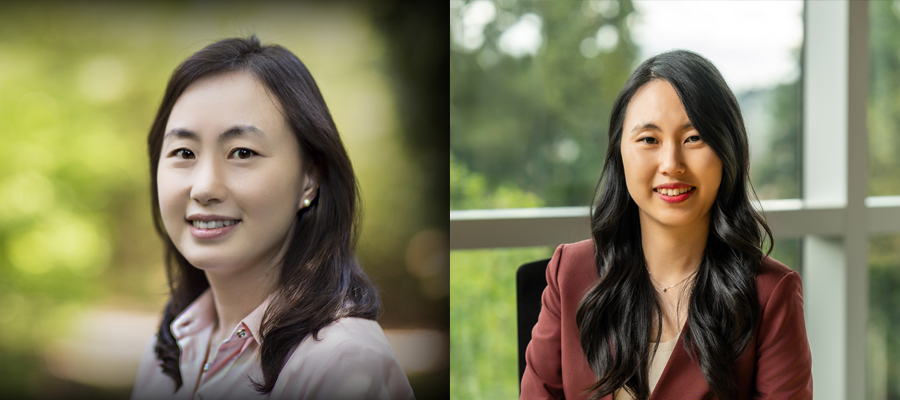
Elina Hwang and Stephanie Lee explore how artificial intelligence can drive positive social impact. One project develops AI chatbots designed to make mental health support more personalized and accessible. Another investigates how AI-generated explanations can improve misinformation labeling and help reduce the spread of false information across digital platforms.

AI and Venture Capital: Understanding the New Investment Landscape
Lea Stern’s AI-focused research bridges academia and industry impact. Her current projects include using machine learning to analyze venture capital allocation and leading an Anthropic-supported study, “Who Funds the Frontier?”, which maps the investors backing breakthrough AI. She has helped shape global dialogue around AI in finance by co-organizing the AI & Big Data in Finance Forum for three consecutive years, and will soon help launch a new junior-scholar AI series. Beyond Foster, Lea shares her expertise through guest lectures and media interviews and contributes to the year-long Longitudinal Expert AI Panel (LEAP) survey. As an AI Ambassador, she aims to bring leading-edge AI perspectives to the Foster community.
AI-Enhanced Experimentation and Consumer Trust
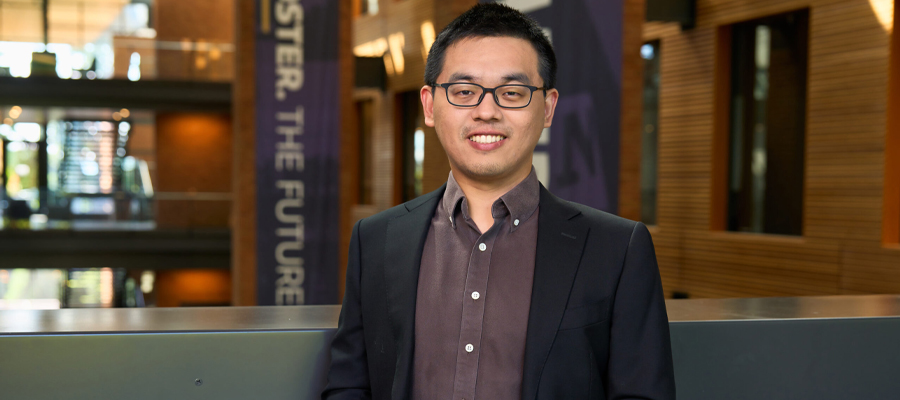
Zikun Ye designs large language model (LLM) systems that transform unstructured text into decision-grade insights for market research, experimentation, and consumer trust. His work includes developing LLM-based algorithms that accelerate market research and A/B testing, and quantifying how AI influences consumer risk perception to inform business strategy.
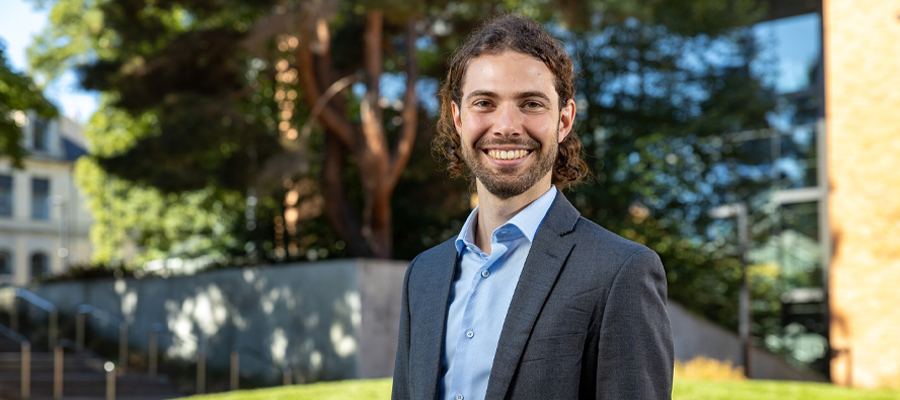
Léonard Boussioux develops methods that democratize expert-level problem-solving by combining generative AI, operations research, and large-scale experimentation. His 2024 Organization Science paper, one of the journal’s most widely read worldwide, demonstrated how strategic human-AI collaboration can reduce costs by 99 percent while improving solution quality. Building on this research, his AI-driven review system now helps MIT Solve streamline the evaluation of thousands of social-impact startups, allowing experts to focus on creativity and impact while dramatically shortening the screening cycle. At Foster, he leads GenAI bootcamps and graduate courses that train hundreds of students and industry professionals to accelerate innovation and decision-making with generative AI.

Uttara Ananthakrishnan studies how AI and digital platforms shape economic behavior, information flows, and user decision-making at scale. Her projects analyze large datasets from online marketplaces and review systems to understand how platform design influences participation, content creation, and the spread of information. Her work offers evidence-based insights for improving platform performance and strengthening the quality of digital interactions. At Foster, she brings these findings into the classroom and broader AI initiatives, helping students evaluate how algorithmic systems influence business strategy and consumer behavior.
Join the Conversation: AI Events at Foster
Foster hosts events that bring together students, faculty, and industry leaders to explore how AI is shaping business and society through ongoing programming and signature events.
Event Spotlight: Global AI Summit
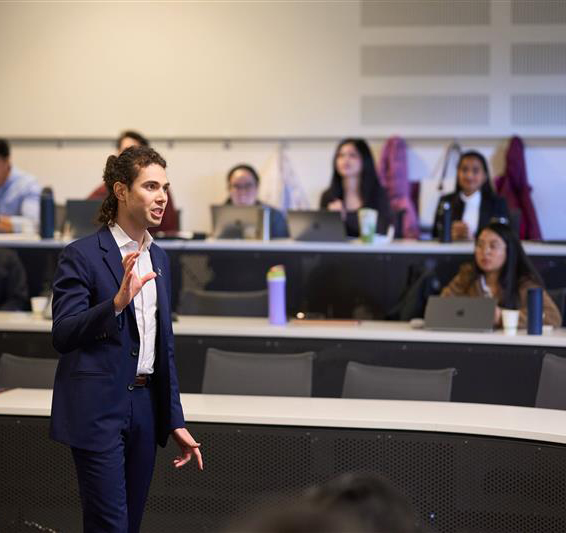
Full-time MBA students participate in Foster’s first AI Bootcamp, led by Professor Léonard Boussioux.
In March 2025, Foster hosted the UW Foster Global AI Summit, bringing together faculty, students, and industry leaders to explore the future of AI and human-centered innovation. The event featured keynote speakers, panel discussions, and student presentations — positioning Foster as a hub for responsible AI leadership. Read the recap.
Ongoing AI Events & Opportunities
AI Hackathons
Cross-campus competitions where students tackle real-world challenges using AI tools.
Lunch & Learn Series
Faculty and staff share hands-on use cases of AI in teaching, research, and operations.
Industry & Alumni Salons
Invite-only gatherings with tech leaders and Foster alumni shaping AI innovation.
MSIS Demo Day
Annual spring showcase of student-designed AI solutions.
Media Mentions
AI’s growing role in wildfire response
Axios
Read the article
Meta layoffs starting this week stress harsh AI reality inside Zuckerberg’s company
CNBC
Read the article
Meta began laying off 8,000 people this morning. Now what?
HCA mag
Read the article
‘It made me a little bit kinder’: How managers use AI to make decisions
Fast Company
Read the article
How UW Foster is Thinking about AI Education (and Why it Matters for Your MBA)
Behind the MBA
Read the article
Meta’s Embrace of A.I. Is Making Its Employees Miserable
The New York Times
Read the article
More
See more about the University of Washington’s AI initiatives here
See Foster’s Full AI Syllabus Statement
See AI certificates, concurrent degrees and specializations