

When interest rates rise or a market shock hits, investors have to ask: What will this mean for the companies I’ve invested in? Answering that depends on knowing how those companies actually work. And some are far harder to figure out than others.
That difficulty has a name: business complexity.
Researchers have tried to measure it before, using proxies like how many business divisions a company has, or how long and dense its annual report is. But those approaches capture only parts of the picture.
Elizabeth Blankespoor and Darren Bernard, both accounting professors at Foster, spent years trying to do better. They ultimately trained an AI model to read company reports the way a seasoned analyst would, and used its confidence as a measure of complexity.
For Bernard, whose research keeps returning to how people use public information, complexity was a dimension always lurking in the background.
“It’s something that overlays pretty much every disclosure topic,” he says. “You’re always kind of guessing at how complex things are — there’s not a great measurement for it. The point here is to actually create a measure to be able to unpack that a little bit better.”
Blankespoor has spent her career studying how financial information moves from companies to investors, and where that process breaks down.
“Business complexity is a huge source of that breakdown,” she says. “Can we actually disentangle it from other forms of complexity, from other kinds of frictions?”
Their findings, developed with co-authors Ties de Kok and Sara Toynbee, are documented in “Using GPT to Measure Business Complexity,” published in The Accounting Review.
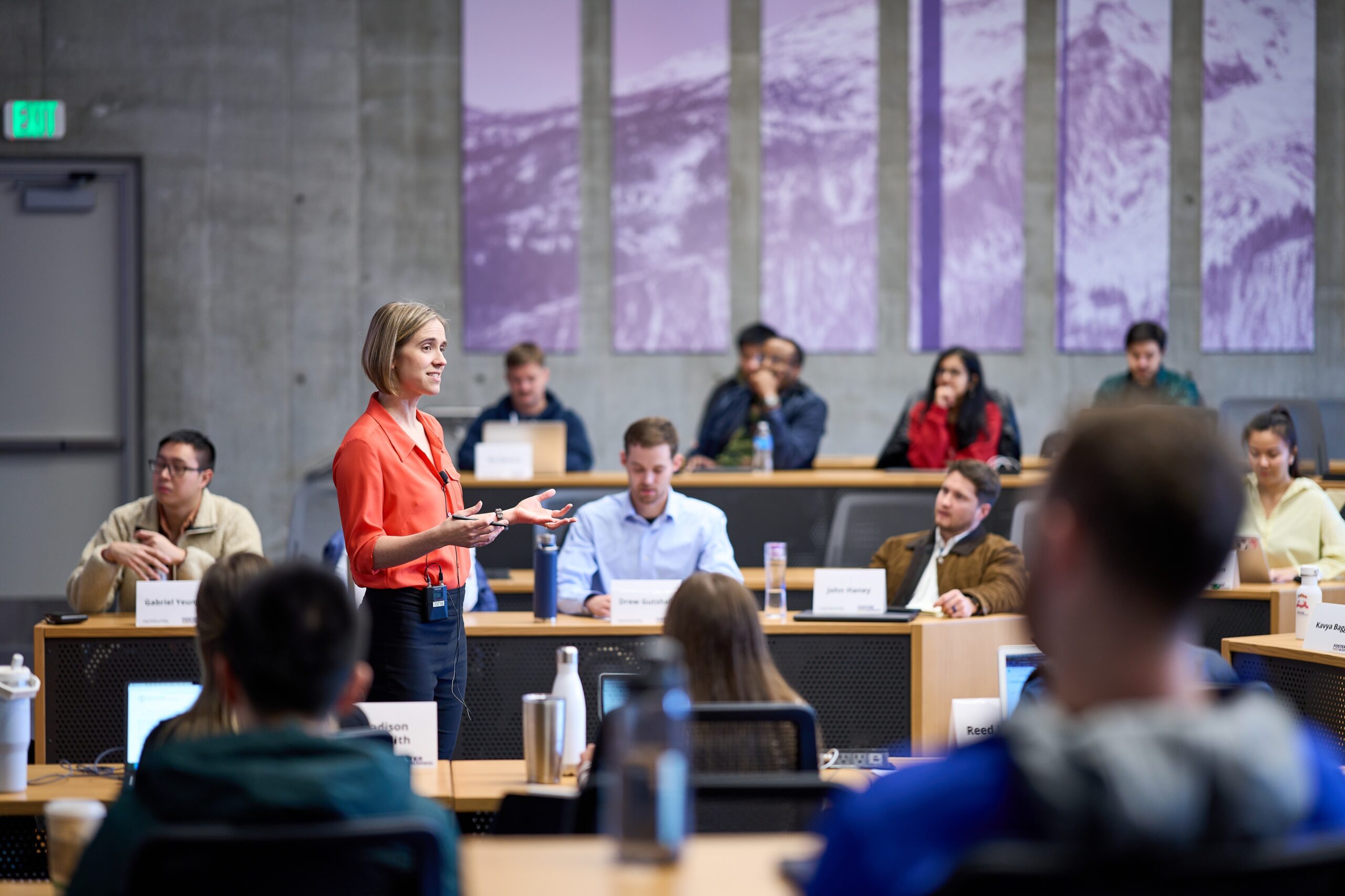
Elizabeth Blankespoor, a favorite professor among Foster MBA students, is known for turning even the biggest skeptics into believers in accounting.
Teaching an AI model to read like an expert
U.S. public companies are required to tag the numbers in their financial reports with standardized labels: a kind of machine-readable shorthand that identifies what each number represents. The research team trained Meta’s open-source Llama 3 AI model on 200,000 examples of these tagged financial disclosures, teaching it to read the surrounding text and predict what label should apply to each number. Then they ran it across more than 8 million figures from over 50,000 company reports filed between 2016 and 2024.
The key insight was to use the AI model’s confidence as a proxy for complexity.
“Think of it like asking a highly trained analyst to read a company’s annual report and articulate what every number represents,” Blankespoor explains. “The model’s confidence in its prediction becomes our measure of complexity. When it’s confident, the concept is likely straightforward. When it’s uncertain, we’re probably looking at something that’s genuinely hard to understand.”
One validation test gave the team particular confidence in the approach. When they used another AI tool to rewrite financial disclosures in simpler language (shorter sentences, plainer words) and then re-ran their model, the model actually became less confident, not more.
“If you give a seasoned financial analyst a report that uses all the wrong words, they’d say, ‘I don’t know why they’re using these words — you don’t use those words, you use these other words,'” Bernard says. “It gave us comfort that we were really capturing a well-trained reader.”
The model wasn’t measuring how readable the writing was. It was measuring how hard the underlying business was to understand.
For Blankespoor, the paper is also a proof of concept for what AI models make possible in accounting research more broadly.
“This paper specifically — we just couldn’t have done it before,” she says. “It’s just not possible.”
Where researchers once had to rely on crude proxies, or skip questions entirely because the data were too labor-intensive to gather, models like this one can now do in minutes what would have taken months. The questions that were too hard to ask are becoming answerable.
The price of business complexity
The measure produces intuitive results at the industry level.
“When you open an annual report from Bank of America, oh my god, the complexity you find in there,” Bernard says. “But at the other end of the spectrum, you have retailers — fairly straightforward businesses.”
More consequentially, the team found that companies with more complexity are harder for investors to process. That shows up in stock prices. When a company publishes its financial results, investors absorb that information and adjust what they’re willing to pay for the stock. For complex companies, that adjustment takes measurably longer. The more complex the business, the slower the market reaches a stable new price.
“Complexity increases processing costs,” Blankespoor says. “And to the extent those processing costs affect investors’ allocation of limited attention, you’d expect it to affect the speed of the price response. That’s what we see.”
Crucially, this effect held up even when the researchers controlled for the older ways of measuring complexity: report length, reading difficulty scores, sheer volume of reported figures. None of those captured the same thing, or predicted the same slowdown.

Known for making accounting unexpectedly engaging, Darren Bernard brings insights from his research into the classroom.
When complexity is the point
One of the tool’s strengths is that it works at the category level, meaning the researchers could examine not just how complex a company is overall, but which parts of the business drive that complexity. They chose to focus on debt, the single richest source of complexity in the dataset.
The question they asked was pointed: Why do financially struggling companies tend to have the most complex debt arrangements?
The data suggested that debt complexity is often the result of necessity. When a company is in a difficult financial position and needs to borrow money, it has to negotiate harder to get a deal done. Lenders demand more protections; borrowers push for more flexibility. The result is a set of arrangements that’s more complicated than either party might prefer, but better suited to both than a standard deal.
And the data suggest those arrangements pay off. Companies with more complex debt showed more stable borrowing costs over time and held up better during the inflation and interest-rate surge of 2021 to 2022.
“It suggests there’s a role for complexity, that it can be beneficial,” Blankespoor says, though she’s careful to add that the research is indicative rather than definitive. Exactly when and for whom debt complexity is worth it is a question she hopes future researchers will take up.
An AI tool for researchers, companies, and classrooms
The AI model and complexity scores are publicly available, and other researchers have already begun using them.
“The granularity is the point,” Blankespoor says. “Researchers can narrow in on whatever is relevant to their specific question: revenue complexity, compensation complexity, you name it.”
Bernard sees practical applications for companies as well. A firm preparing its annual report could run it through the model to identify sections where the measure flags low confidence, a signal that something might be hard for investors to interpret. That won’t replace human judgment, but it could surface blind spots.
In the classroom, Blankespoor uses the research to make the concept concrete.
“Being able to show that business complexity has real implications — that it slows down how quickly the market can process your financials — makes students aware that these are real trade-offs companies face,” she says. “And then ideally it spurs more research: For this specific decision, is the complexity worth it or not?”
Read the research paper: “Using GPT to Measure Business Complexity” — Darren Bernard, Elizabeth Blankespoor, Ties de Kok, Sara Toynbee. The Accounting Review.
Darren Bernard is the KPMG Term Professor and an Associate Professor of Accounting at the University of Washington Foster School of Business.
Elizabeth Blankespoor is the Marguerite Reimers Endowed Faculty Fellow and a Professor of Accounting at the University of Washington Foster School of Business.