

Peter R. Fisher has spent much of his career at the intersection of financial theory and consequential decisions.
He has conducted monetary operations for the Federal Reserve, advised the U.S. Treasury secretary, and led global investment teams at BlackRock, managing more than $1.3 trillion in fixed-income portfolios. He has worked through financial crises, wrestled with questions of monetary policy and financial stability, and spent years thinking about how people make decisions.
Now, Fisher is bringing that experience to Seattle as a Professor of Practice of Finance at the University of Washington Foster School of Business.
His appointment comes as Foster launches its one-year Master of Science in Finance. Fisher will teach in the program, bringing students an unusual combination of experience spanning financial markets, policymaking, and investment management. But most importantly, he’ll bring a teaching philosophy built around putting students into the role of decision-makers.
“Having someone with Peter’s immense expertise and experiences guiding our students through difficult and nuanced issues is invaluable and a competitive advantage for the Foster School,” said Frank Hodge, Orin & Janet Smith Dean of the Foster School of Business.
Fisher spent 16 years at the Federal Reserve Bank of New York, ultimately serving as executive vice president and manager of the System Open Market Account, responsible to the Federal Open Market Committee for the conduct of domestic and foreign currency monetary operations. He later served as Under Secretary for Domestic Finance at the U.S. Department of the Treasury, advising the Treasury secretary on financial institutions, public debt management, capital markets, and other areas of domestic finance.
He then joined BlackRock, where his senior leadership roles included serving as chairman of BlackRock Asia and head of Fixed Income. He later led BlackRock’s Global Retirement Initiative and today serves as a senior advisor to the firm’s CFO.
As he makes the move west, we caught up with Foster’s newest finance professor to talk about the classes he plans to teach in Seattle and his take on the most important question students should ask.

Peter R. Fisher, Foster’s new Professor of Practice of Finance, brings decades of experience at the Federal Reserve, U.S. Treasury and BlackRock to the classroom.
What attracted you to the Foster School and to Seattle?
Peter R. Fisher: I love teaching, and I wanted to continue that at Foster. I love helping students learn how to think about finance.
Seattle was also a big draw for both family and professional reasons. There are extraordinary companies and financial leaders here, and that creates tremendous opportunities for the classroom. I’m looking forward to being part of Foster and bringing together what I’ve learned over my career with the expertise that’s already here in this community.
You developed a course called The Arrhythmia of Finance, which you taught at Dartmouth and MIT. What is the focus?
Peter R. Fisher: Decision-making under uncertainty is the central focus.
For 35 years, I hired and trained MBAs and other grads at the Fed, Treasury, and BlackRock. Many were extraordinarily smart. They had deep quantitative skills. But very few came in with an understanding of the central role of uncertainty in finance and how balance sheets and balance-sheet mismatches are where the uncertainties will play out.
It’s good to know what’s going on in the income statement, but if you don’t understand the balance sheet, you’re not yet in the game.
We’re always long something and short something. Students should learn how to ask, What does that mean? What is risk? What’s intrinsic value? What’s uncertainty rather than probability? How do assets and liabilities interact?
Those are the kinds of questions I want students to wrestle with.
I’ve been developing and refreshing the course over the years because finance keeps changing. The underlying questions endure, but the problems we use to explore them don’t. I’m looking forward to bringing that approach to Foster.
How do you approach teaching finance?
Peter R. Fisher: Students working on real problems where the answer isn’t sitting neatly in front of them.
One former student described my classroom as being “like a day at the office.” That is just what I’m trying to do. Imagine your boss calls you into the office and says, “Here’s a problem. What do you think we should do?” I try to recreate that moment in my classroom as often as I can.
What do you want students to be able to do when they leave your classroom?
Peter R. Fisher: I want them to become people who can help solve the most difficult problems. The attitude I want students to adopt is to keep asking their boss: “What is the most pressing problem you’re working on, and how can I help you?”
You won’t solve every difficult problem. But if you are trying to do this, you will learn so much more, your judgment will become more valuable, and you will get more interesting assignments. People will want to know what you think.
This is an important part of becoming a professional. It isn’t only about what you know. It’s whether you can bring what you know to bear on a problem that matters.
Is there one question you want students to carry with them?
Peter R. Fisher: I want students to take seriously the likelihood that they could be wrong. To ask, “Why might I be wrong?”
It’s not enough to have an answer or even to be able to defend it. You need to understand the assumptions behind it, recognize what you don’t know, and be willing to scrutinize your own judgment.
The objective isn’t skepticism for its own sake; it’s better judgment.
You’ve worked at the Federal Reserve, Treasury, and BlackRock. How will that experience come into your Foster classroom?
Peter R. Fisher: All my scar tissue, going back 40 years, will come into the classroom.
But I’m not trying to teach students how to become central bankers. I want to teach them to think carefully about the world and to become skeptical consumers of what both the central banks and the banks are telling them.
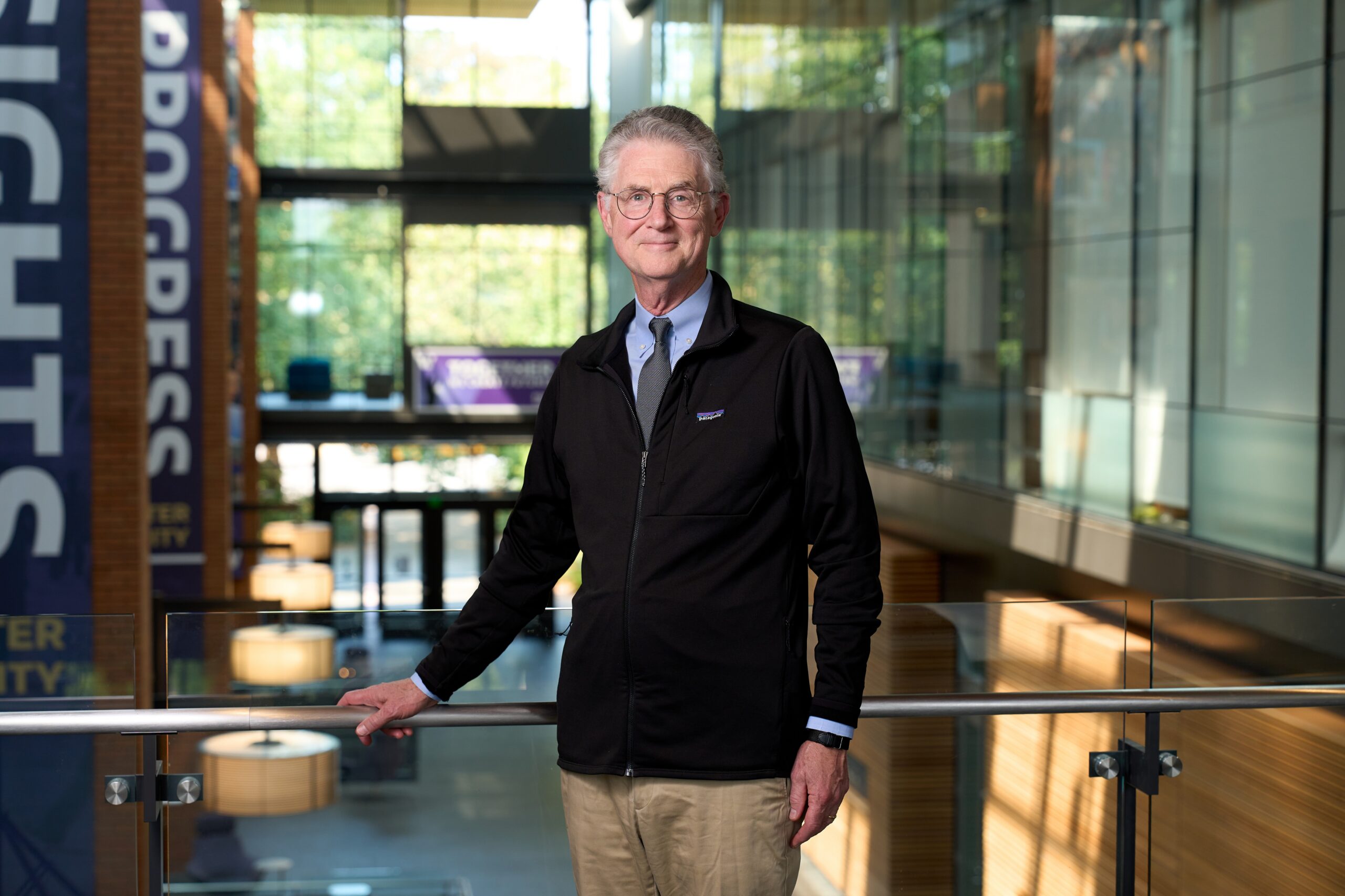
Peter R. Fisher, Foster’s new Professor of Practice of Finance, will draw on a career in markets, monetary policy and investment management to teach students how to make decisions under uncertainty.
Return to the Federal Reserve
Fisher will bring another unusually timely source of experience into the Foster classroom.
In July 2026, Federal Reserve Chairman Kevin Warsh named Fisher to the Fed’s Communications Task Force, one of five task forces convened to examine the conduct of monetary policy. Fisher is serving alongside Mervyn King, former governor of the Bank of England, and Arminio Fraga, former president of the Central Bank of Brazil.
The assignment places Fisher back inside a debate he has spent decades helping shape. At the New York Fed, he was responsible to the Federal Open Market Committee for conducting domestic monetary operations and foreign currency operations. At the U.S. Department of the Treasury, his responsibilities ranged from capital markets and public debt management to financial institutions and federal financial policy. And he has continued to write and speak about monetary policy, financial stability, systemic risk, and the Federal Reserve throughout his career.
Now he and his fellow task force members are being asked to examine how the world’s most influential central bank communicates its decisions.
Experience becomes the curriculum
Fisher’s résumé provides plenty of stories to tell. But in Fisher’s classroom, experience isn’t the story. Experience is the curriculum.
The Arrhythmia of Finance demonstrated what that can mean for students. The course began with deceptively simple questions—What is the role of chance in your life? What is risk?—before moving through balance sheets, money, expectations, intrinsic value, and increasingly complex problems drawn from financial markets and institutions.
Fisher developed the course from decades spent hiring, training, and working alongside talented people. He concluded that technical sophistication alone isn’t enough; people need critical thinking skills.
Now, Fisher will bring that approach to Foster. Students will encounter finance not as a collection of formulas with predetermined answers, but as a series of consequential decisions about markets, institutions, risk, and uncertainty.
After a career spent making those decisions himself, Fisher wants students to become comfortable with the question: Why might I be wrong? Ultimately, his course is not about the answers; it is about asking the most important questions.