

Jordan Nickerson has heard the “finance bro” stereotype enough times to have a theory about where it comes from.
He’s part of the faculty shaping Foster’s new Master of Science in Finance (MS in Finance), a pre-experience program designed for students who want to build serious analytical depth before entering the workforce. The program prepares students for careers in corporate finance, investment analysis, consulting, fintech, and technology-driven financial strategy.
“People think of trust fund kids who go into finance because their parents did it, and for the glamour of Wall Street,” says Nickerson, an Associate Professor of Finance and the Peter and Noydena Brix Fellow at the University of Washington Foster School of Business. “They think of the salespeople and the schmoozers—trying to win you over with a firm handshake.”
That misconception, he says, is one of the biggest obstacles people bring to the field. And dismantling it is part of what drives his teaching.
“Finance is a field where you get incredibly talented problem solvers who are tasked with problems that have really high stakes,” says Nickerson. “You’re asked to work through all the scenarios to figure out the best thing to do—and these are not small decisions. Maybe you’re figuring out the best thing to do with $500 million.”
Nickerson joined Foster in 2017 and teaches finance at both the undergraduate and graduate levels. Nickerson researches corporate finance and political economy, with a particular focus on how government policy and regulation shape the decisions businesses actually make. He also studies the gig economy and the labor classification questions that ripple through it.
The matchmaker at the center of everything
For Nickerson, finance is fundamentally about connection. On one side: ideas without resources. On the other: resources without ideas. Finance is what brings them together.
“It could be a venture capitalist with the money and an entrepreneur with the idea, and finance finds a way to bring these two together to fulfill a vision,” he says. “Or it could be a company ready to scale, finding a way to reach the investors who can help it go public. Finance sits in the middle, making those relationships possible.”
But Nickerson is quick to add that this high-level framing is only the starting point.
“What’s interesting about finance is that it’s all about the details. It’s about understanding the little nuances and why two propositions differ. What’s the risk involved in this investment versus that one?”
The real work, he says, is thinking strategically, even adversarially. “An investor isn’t just evaluating an opportunity—they’re asking why the other party wants to sell. What do they know that I don’t?”
That’s what finance education needs to train students to navigate. While the analytical rigor of Foster’s MS in Finance goes deeper than that of an undergraduate program, the curriculum stays grounded in motivations and principles, not just the mechanics.
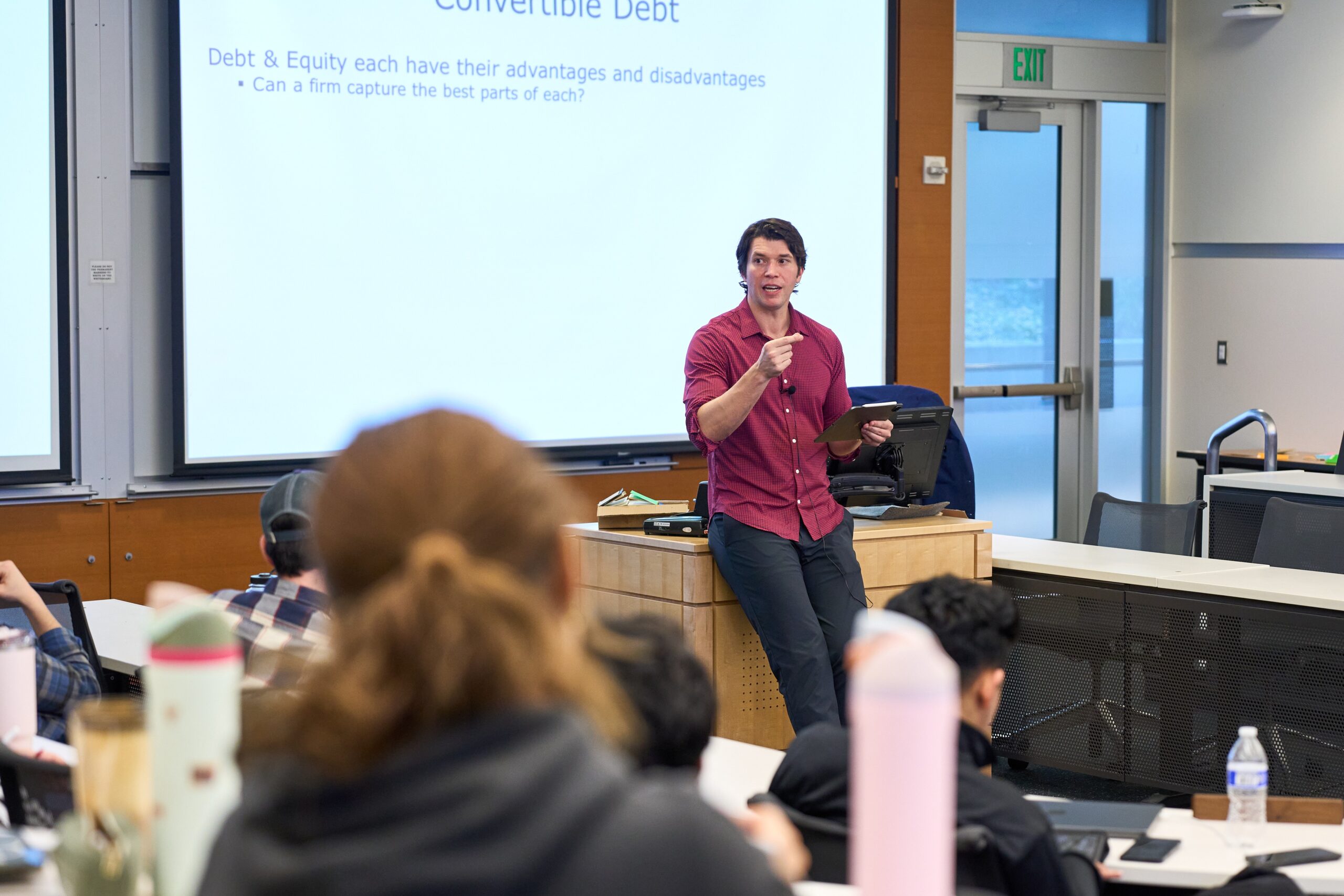
Jordan Nickerson challenges finance students to think critically about risk, strategy, and decision-making.
AI and the future of finance careers
One question that comes up constantly in conversations about finance education is often driven by anxiety: What does AI mean for the people entering the field?
Nickerson draws an analogy to the arrival of the personal computer in the 1980s. Before spreadsheets, every company had bookkeepers tracking finances by hand. The expectation was that computers would make those roles obsolete. They didn’t. “It didn’t lead to a mass exodus. Bookkeepers used that tool, and it made them more effective.”
His read on AI is similar. The difference is that the stakes around discernment are higher. AI systems have been trained on the same internet that Nickerson tells his students not to fully trust. “We’re not in a world where one plus one equals two—a computer can do that as well as a human. We’re in the world of finance, which is the world of ambiguity.”
That ambiguity doesn’t disappear with better tools. It requires someone who understands the trade-offs well enough to catch when the model gets it wrong.
That’s why the MS in Finance curriculum treats AI as a force multiplier rather than a shortcut. Students will work through case analyses where AI is available to use, and then the real learning happens: examining the model’s approach, identifying where it went astray, and understanding what it would take to trust the output.
“We’re going to spend a lot of our time on: what were the assumptions it made? What did it do that was not correct? What were the pitfalls?”
The goal is to build a student who can direct AI, rather than one who depends on it.
An MS in Finance rooted in Seattle and the Pacific Northwest
Part of what makes Foster’s MS in Finance program distinctive is its location. Foster’s connections across Seattle’s corporate, finance, consulting, and technology ecosystem give students a direct pipeline into the kinds of companies the program is designed to prepare them for.
Nickerson sees that alignment as more than geographic convenience. “Seattle attracts a certain type of person who is adventurous, both in their activities and in the entrepreneurial spirit they bring to their career,” he says. “Those are the kinds of people we’re drawing as students, and those are the kinds of companies they’ll work with.”
Curiosity as a prerequisite
Beyond an adventurous streak, there’s one quality Nickerson looks for above all others in a candidate for the MS in Finance: curiosity.
“I want the student who is always asking why, pushing a little further, and following a thread past the end of class,” he says. Someone whose approach is: “‘The professor said this, and it piqued my interest, so after class I started Googling to understand it better, and here’s what I found. I wonder if that’s connected.’”
To Nickerson, that kind of intellectual restlessness is a professor’s dream. It’s also, he suggests, what the industry actually selects for—and will get MS in Finance graduates much further than a firm handshake.
Learn more about the MS in Finance.
Jordan Nickerson is an Associate Professor of Finance and Business Economics and the Peter and Noydena Brix Fellow at the Foster School of Business. He will teach in the school’s new master’s in finance program, where students engage with the kinds of real-world financial questions explored in his research.