

For Peter Gilroy, the hardest thing to explain about his job is the job itself.
“My family struggles to understand what I really do,” he says. “When I describe investment banking, I say we advise companies through some of the highest-stakes and most consequential decisions in their history.” He’ll try to walk them through capital markets and mergers and acquisitions, and it rarely lands. What does land is the reason he’s still working at three in the morning, which is that the deal is the most important thing happening for that client and it isn’t going to wait.
Gilroy (MBA, 2019) covers semiconductor companies on the investment banking side at Morgan Stanley. It’s a career that started in the U.S. Army and took shape in the University of Washington Foster School of Business Full-Time MBA program.

Peter Gilroy at an Afghan National Police Station overlooking the Helmand River in 2010.
Finance is the language of business
Gilroy majored in marketing and finance as an undergraduate, but he was attending school on an ROTC scholarship and already knew what came next. He was commissioned into the Army and served nearly 11 years. When he started thinking about a change, he approached it the way he now approaches a client’s options, by looking at where he was, where he wanted to be, and what connected the two.
“I look at things that are common threads,” he says. “Finance is the language of business. Every business in every industry involves finance. I knew if I could speak that language and develop that skill set, I could do just about anything.”
Investment banking appealed to him most, in part because of how close it sits to the decisions that matter. “Because the work is so critical to the business, you get significant exposure to the strategy and decision-making behind these transactions.”
Trained to move before the picture is clear
Gilroy is still in the U.S. Army Reserves, and when you ask him how the two careers inform each other, he starts with the thing both have in common.
“My background was a combat arms officer, so I was used to training and leading teams and operating in ambiguity,” he says. “Those are themes in finance as well. There are numbers. But you have to understand the context, be able to apply judgment, and then build an understanding of what those numbers mean and what you can do with that information.”
An officer looking out at the fog of war is never going to have a complete picture, and neither is a banker advising a company on the largest transaction it will ever attempt, he says. In both cases you assemble what understanding you can from data and context, and then you decide.
The parallels extend to how the work gets done. In a small unit, Gilroy was constantly coordinating with what the Army calls external enablers, the specialists who brought capabilities his own unit lacked. “The same is true in banking, in a weird way,” he says. “If I’m pitching a product, I’m coordinating with the product’s team because they’re the experts. I can deliver that expertise to our clients.”
Then there’s pressure, which he’s careful not to equate across the two. In the military, the stakes are lives, and in finance they’re jobs and the survival of a company. “This work has high stakes and you have to treat it that way. Coming from a military background and being able to operate with that level of pressure transfers fairly well.”
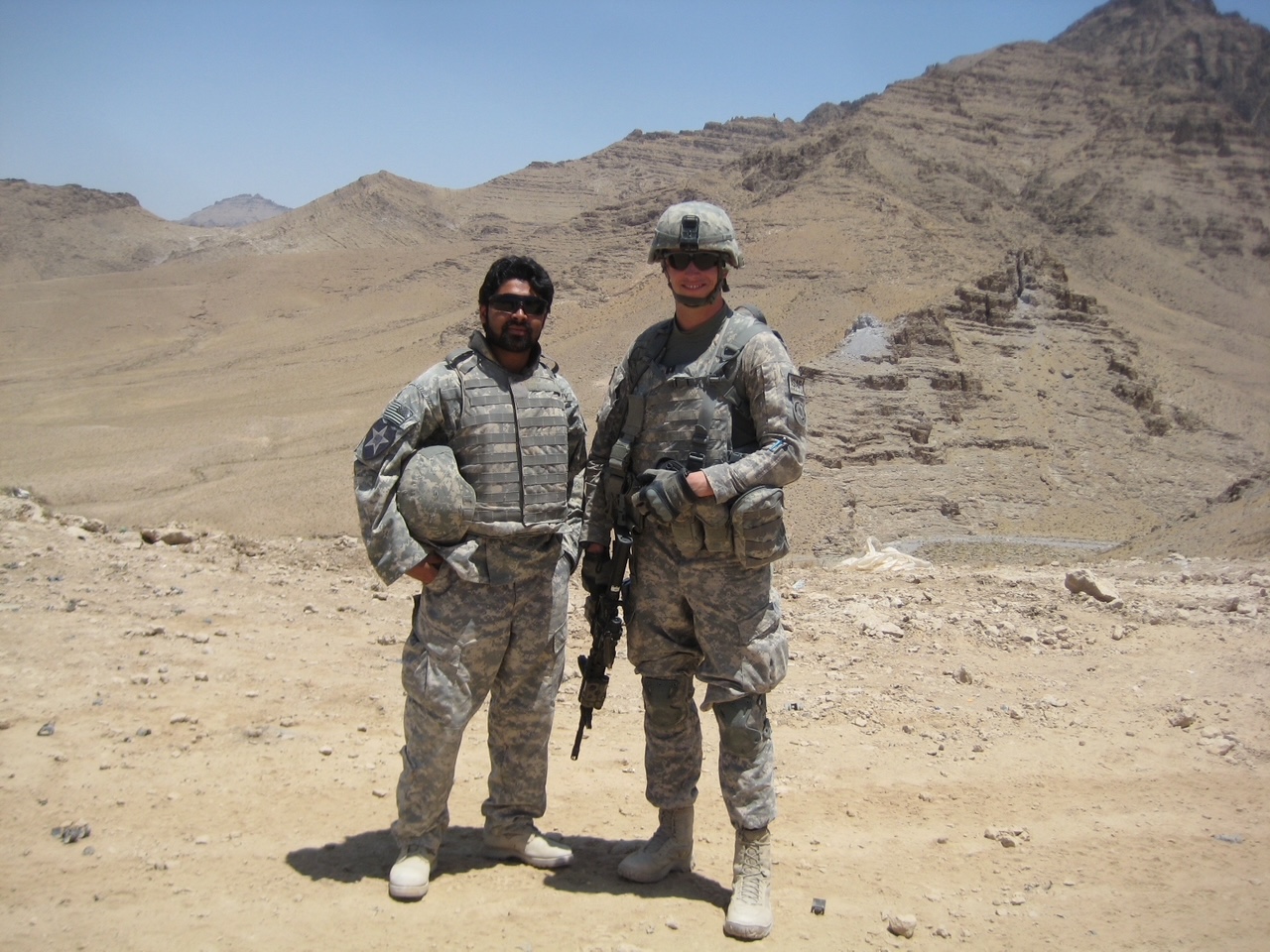
Peter Gilroy with his interpreter in Uruzgan Province, Afghanistan, in 2010.
Choosing the MBA program before the career path
Gilroy picked the Foster School of Business Full-Time MBA before he picked investment banking, which he acknowledges is the opposite of how it’s usually done. Cohort sizes were small enough that he’d get to know his classmates, and the backgrounds in the room were unlike anything he expected.
“I’d be working in a small group with somebody from the Peace Corps, and there would be a military officer, and somebody else that was in private wealth management or financing for movies,” he says. “So while I felt different, I also felt like I fit in.”
He was the only person in his class recruiting for investment banking, an outlier in a cohort aimed largely at Seattle’s technology and consumer companies. It turned out not to matter. The finance department is where things clicked. Gilroy took every class he could, including a core finance course with Thomas Gilbert and coursework with Jennifer Koski, who holds the Kirby L. Cramer Endowed Chair in Finance and began her career at Goldman Sachs. He also took several classes with Lance Young and was in the Foster Research Partners program. Hearing the work described by faculty who had spent time on the other side of the table further fueled his interest.
That summer he worked alongside interns from Chicago Booth and Georgetown, and by the end of it he had a return offer as an Investment Banking Associate. Not all of them did. “The school gets you through the door. But you have to perform. I got the technical skills from that collaborative environment that I needed to prepare me for the job I wanted.”
“Don’t be scared of the math”
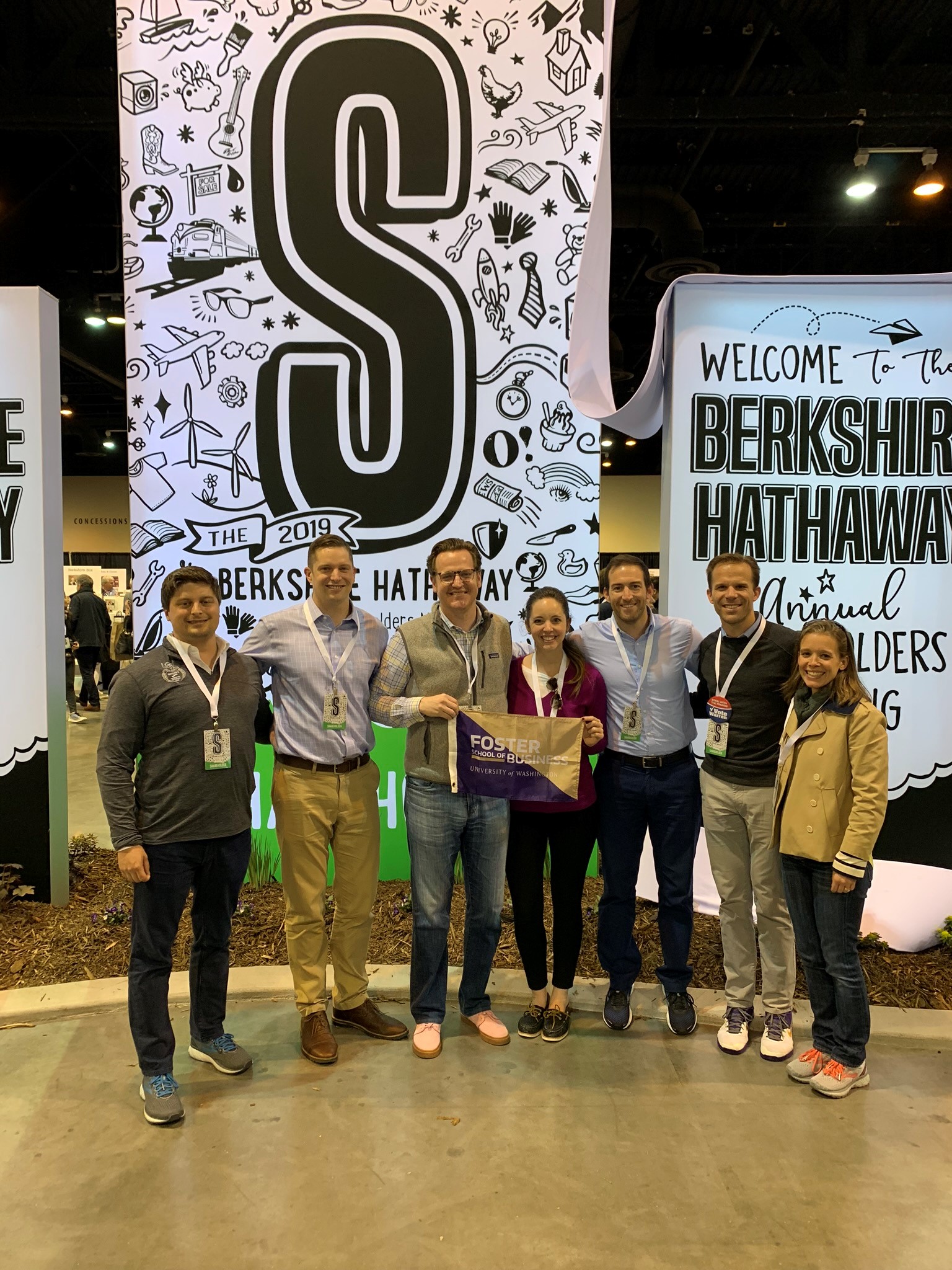
Gilroy, second from left, with Foster students, alumni and faculty at the 2019 Berkshire Hathaway shareholders meeting.
That’s the first thing Gilroy says to anyone worried that a non-finance background disqualifies them from the field. “There is a baseline level of quantitative proficiency required, but the math itself isn’t overly complex. At the higher end we use regression analysis and discounted cash flow calculations.”
His own team makes the case better than any argument could. He works with colleagues who don’t have business degrees, with computer science majors and engineers, and with people who pivoted in from corporate finance.
“Everyone brings something different,” he says. “And if you lean into that difference, it can help differentiate you.” Banking runs on an apprenticeship model, so the technical knowledge comes with the job. What can’t be taught is the unique background you already bring.
His one caution may disappoint anyone hoping to work only with numbers. “You have to be able to communicate with clients and connect with people. Banking is fundamentally a relationship business, so you need to be a bit of a jack of all trades.”
Where AI fits in finance, and where it doesn’t
Gilroy’s firm has been front-footed about AI, and so has he, finishing work on timelines that wouldn’t have been possible a few years ago. He’s equally clear about where the role of AI stops. “AI is a tool. It’s not a replacement for anyone. Our clients are human. And AI doesn’t really apply judgment. So it’s on the banker to make that decision.” His read on the shift is unsentimental. “Those who adopt it quickly and learn how to use it effectively will thrive.”
Which brings him back to the two qualities he looks for when hiring.
Curiosity comes first, and he offers himself as the example, covering semiconductors without a semiconductor background and closing that gap by reading constantly.
Coachability comes second, and the people who plateau tend to be the ones who arrive certain they already know how everything is done. “Technical ability and academic credentials are table stakes,” he says. “But the curiosity and coachability will carry you and allow you to thrive.”
Ask him what makes the long nights worth it and he doesn’t start with the deals. He starts with closing dinners, and with the pitch deck that seemed impossible, and the analysis nobody on the team had built before. “Doing tough things together really builds a sense of camaraderie,” he says, “That’s a parallel to the military as well.”
For anyone concerned they’re coming at finance from the wrong direction, especially those considering Foster’s new Master of Science in Finance, the advice Gilroy offers is the same thing he’s proving in his own career. “Everyone starts by learning the same foundation,” he says. “But you should lean into what makes you different as well.”
Explore MBA and Specialty Masters programs at the Foster School of Business.