

The question feels almost too big to answer directly: What will finance look like in five years?
Doron Levit has been thinking about that question for a while, and his answer might surprise you. Rather than forecasting which technologies will win, he’s focused on something more durable: separating the parts of finance that are likely to change from the aspects that almost certainly won’t, and building a curriculum around that distinction.
Levit is the Marion B. Ingersoll Professor of Finance at the Foster School of Business. He’s also one of the architects of Foster’s new Master of Science in Finance degree. He’s spent his career studying corporate governance—how corporations make decisions, who has a voice in those decisions, and how political and financial systems increasingly shape each other. His recent research on shareholder democracy earned first place in the Brattle Group Prize, one of the leading awards in corporate finance scholarship.
But when he talks about what’s coming in finance and finance education, he’s not interested in hype. He’s interested in what holds.

Doron Levit, Marion B. Ingersoll Professor of Finance, at the University of Washington Foster School of Business, where he helped shape the MS Finance program.
Finance fundamentals aren’t going anywhere
Levit thinks about finance in terms of systems. “Finance is basically the ‘oil’ that makes the whole machine run, including the U.S. economy and the global economy,” he says. “It’s really important that you have the right mix, keeping the whole thing running smoothly and efficiently, in a way that maximizes the use of our resources.”
Today, AI is accelerating the automation of trading platforms. Blockchain technology has spawned new asset classes and governance structures. Fintech is redesigning the channels through which money moves. Levit sees all of this as real and consequential, but he draws an important distinction between changes that are reshaping the application of finance and changes that are rewriting its foundations. So far, he’s not seeing much of the latter.
He points to cryptocurrency as an example. Many observers believed blockchain would fundamentally rewrite how financial markets operated, but “the economic forces that dictate how those emerging markets operate have not changed,” Levit says.
He makes the same point about securitization in the early 2000s, when the packaging of mortgage-backed securities contributed to the financial crisis. “There was an innovation that affected financial markets and the economy,” he says. “But fundamentally, we understand what stands behind that.” The principles held. They just needed to be applied differently.
For Levit, that’s not a reason for complacency. If anything, it raises the stakes. Understanding foundational principles matters more than ever, because they’re the lens through which every new technology has to be evaluated.
Where theory meets practice in the MS Finance
This approach is at the heart of how Levit and his colleagues have designed Foster’s new Master of Science in Finance degree, which will welcome its first class in 2027.
Together, Levit and Foster’s finance faculty built the core of the curriculum around financial fundamentals: how assets are priced, how corporations make capital decisions, how markets function and where they break down. “The MS Finance program is centered around making sure Foster students have a deep understanding of fundamentals that are timeless,” Levit says.
Levit acknowledges that while the fundamentals tend to stay steady, the environment in which they’re applied is evolving rapidly. “The question becomes, ‘How do you apply those principles to the changing environment?’” That’s where elective specializations for Master’s in Finance students come in: students in the program have the opportunity to study AI and finance, fintech, cryptocurrency, real estate, and investment strategy, alongside applied content that gets students out of the purely theoretical.
The new Master’s in Finance runs across three quarters, with each quarter including a seminar component designed to bridge classroom learning and real-world practice.
In the first quarter, Foster’s speaker series brings in industry practitioners to show students where the problems their coursework describes are being lived. By spring, students are working in teams on capstone projects with real companies, applying what they’ve learned to real business problems and getting direct feedback from the people trying to solve those issues.
“By the end of the MS Finance, students have not only learned the principles and the emerging trends in theory,” Levit says. “Students have also had an opportunity to hear firsthand from practitioners and finance industry leaders about what they’re currently facing, and then actually engage with them on real problem-solving exercises.”
Connecting finance research with the classroom
Levit’s work on corporate governance sits at the center of one of the more heated debates in business today: should corporations be responsible only to their shareholders, or do they have broader obligations to society?
As pressure has grown on companies to consider their environmental and social impact, and as a political backlash against that pressure has followed, Levit has been studying how those two forces play off each other—how corporate power shapes public policy, and how policy shapes corporate behavior in return.
“If we’re trying to understand and design better financial systems, we can’t just ignore the political aspects of finance,” he says. It’s a relatively underexplored area, and one he expects to become more important.
What’s interesting, from a finance student’s perspective, is how directly that research connects to the philosophy of the new MS Finance. The governance principles at the heart of Levit’s research on public corporations have already surfaced in the crypto world, where participants vote on organizational decisions much the way shareholders do in a traditional company.
“Some of the fundamentals remain the same,” he notes. “The environment is different, the technology is different, but you have this small set of principles that seems to be timeless and broadly applicable.”
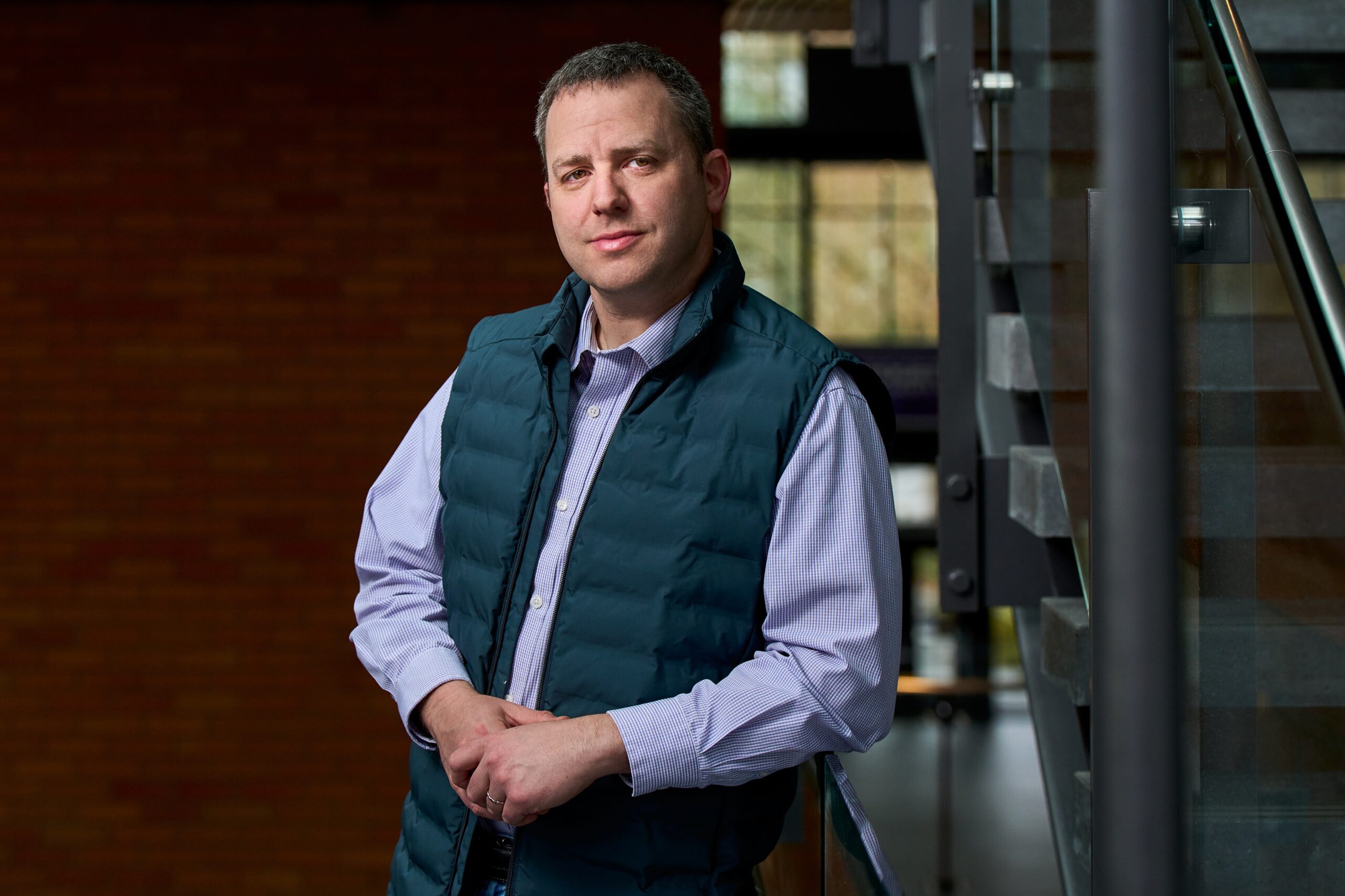
“Finance fundamentals endure—even as technology changes everything.”—Doron Levit, Marion B. Ingersoll Professor of Finance at the Foster School of Business, on the philosophy behind the MS Finance curriculum.
Who the MS Finance is built for, and what students need to thrive
The MS Finance program is designed for early-career students who bring valuable skills from other academic majors, such as engineering, computer science, economics, mathematics, political science, or psychology. Levit sees each of those backgrounds as genuinely useful for understanding financial markets. The program takes that existing foundation and points it in a new direction.
“The MS Finance is designed for students who perhaps took a different path in their undergraduate studies, realized they want to specialize in finance, and want to bring their background from a different discipline to the financial system. This program is designed to capitalize on the connections between that background and a deeper understanding of how finance works.”
What Levit asks of students is demanding but not complicated. He wants curiosity and a willingness to ask hard questions. “You really have to have the courage to ask the right questions, and to try to come up with your own solutions, even though you have very little experience.” To get the full value from this intensive finance program, students need to take a “learning while doing” approach.
For students drawn to the intersection of finance and technology, Levit thinks Foster offers something that’s genuinely hard to find elsewhere.
“Foster brings something unique to the table,” he says. “Students have top-notch finance education combined with the Seattle tech and innovation scene, and the engineering and computer science schools here at the University of Washington. That creates a lot of opportunities for anyone who wants to place themselves at the intersection of finance and technology, whether that’s in payment systems, trading platforms, or somewhere else entirely.”
Preparing for a field that’s still taking shape
Levit is comfortable with uncertainty in a way that feels deliberate rather than evasive. He doesn’t know whether crypto will eventually reshape significant parts of the financial system. He doesn’t know exactly how AI will change market microstructure over the next decade. But he strongly believes that the people best positioned for whatever comes next won’t be the ones who bet on any single technology. They’ll be the ones who understand the principles well enough to evaluate every new development on its own terms.
“In a world where technology and knowledge are moving so fast,” he says, “you really want to learn from people who are at the front of that knowledge creation.” At Foster, he doesn’t have to look far to find them.
Learn more about the Master of Science in Finance at the University of Washington Foster School of Business.