

When several wildfires are burning at once, one question becomes especially important: Where can limited firefighting crews make the biggest difference?
Foster assistant professor Léonard Boussioux has been thinking about some version of that question for most of his life. Growing up in French Catalonia in southern France, he lived through wildfires every summer and watched firefighters and aircraft battle blazes near his town. Even as a child, he wanted to find a way to help.
“As a kid, it was my dream to leverage patterns to solve problems,” Boussioux says. He always wondered whether patterns in how fires behaved could help reveal what would happen next. When he encountered AI during his undergraduate studies, he recognized what had been missing: a way to train a machine to find those patterns for him.
Wildfire suppression later became a project in an optimization course with MIT Professor Alexandre Jacquillat. When Boussioux became a faculty member, it was one of the “dream projects” he finally had the opportunity to pursue.
Now, in new research with three researchers at MIT, he is pursuing his childhood ambition in earnest. Boussioux and his collaborators have developed an approach that combines two models. A predictive machine-learning model, a form of AI, estimates how individual fires may evolve and how sending additional crews could change their course. An optimization model then uses those predictions to determine where firefighting crews could have the greatest effect across multiple fires and days.
Fire prediction meets optimization
Before the research team could get to work, Boussioux had to make the existing wildfire data usable.
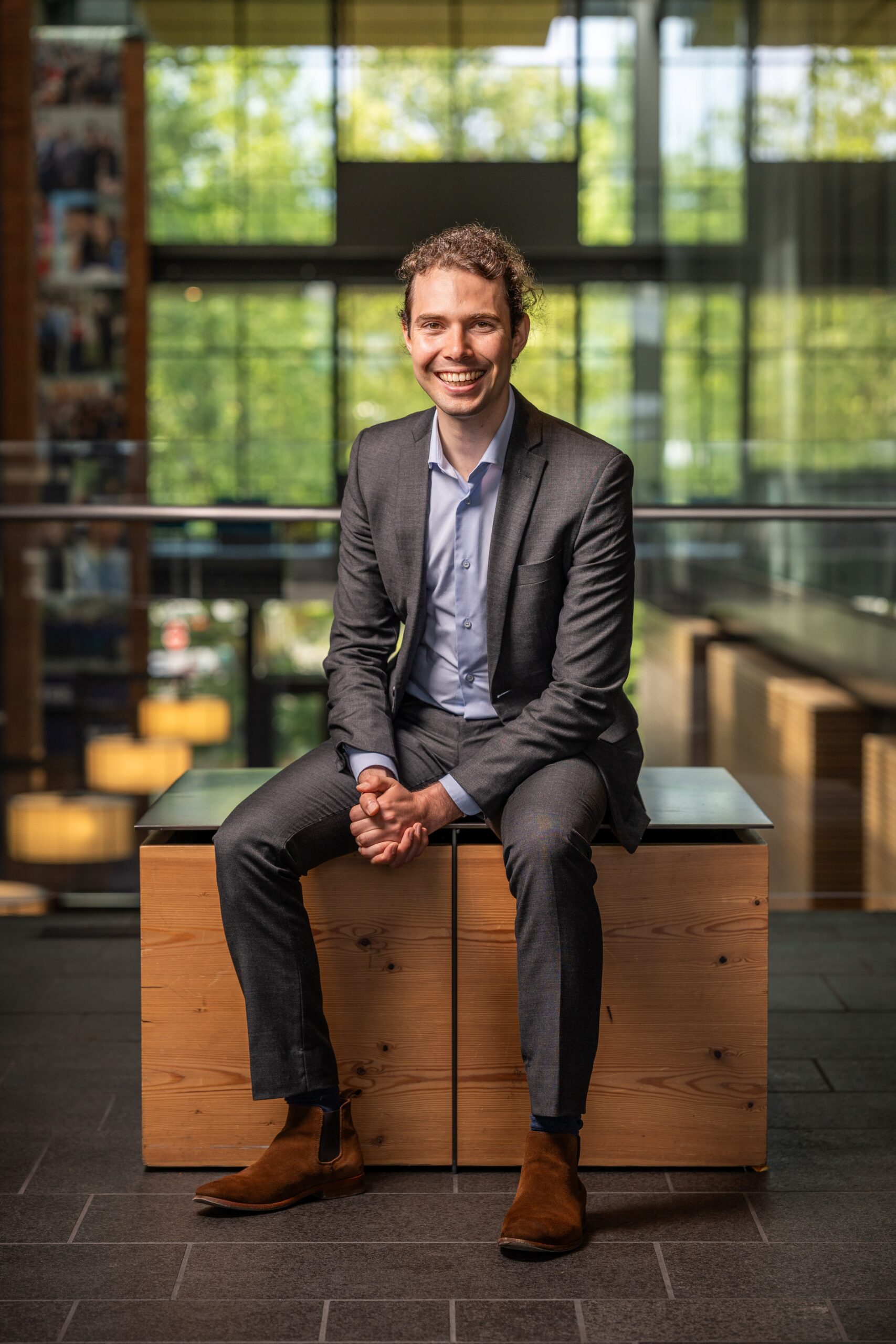
Léonard Boussioux grew up watching wildfires threaten his region. Now he’s using AI to help fight them more effectively.
“The hardest part was all about the data,” Boussioux says.
In 2024, a new generation of AI reasoning models gave him a practical way to clean and prepare the data for analysis. From there, Boussioux leaned into one of his specialties, bringing together different kinds of information to get a fuller picture. The team combined historical wildfire and firefighting records with weather, terrain, and vegetation data and quickly incorporated newly available AlphaEarth satellite embeddings from Google DeepMind, which turn satellite imagery into machine-readable information about the landscape.
“What’s exciting about this problem is that it’s two big pieces that we joined together,” Boussioux says. “There’s a piece around optimization, and there’s also a piece about prediction.”
First, a predictive model estimates how a fire may evolve based on weather, terrain, vegetation, and the level of firefighting support. Then the optimization model looks across many fires and multiple days to determine how limited crews could be deployed to reduce the total area burned, while accounting for travel and required rest.
Even the prediction piece presented a counterintuitive challenge. Historically, the biggest, most dangerous fires tend to get the most firefighters. A conventional machine-learning model could therefore see more firefighters alongside larger fires and draw exactly the wrong conclusion.
Boussioux and his collaborators instead had to separate why crews were sent from what those crews actually accomplished. That allows the predictive model to estimate how much difference another crew could make. The optimization model can then weigh all the fires and days ahead to decide where crews could have the greatest impact.
“I was surprised to see how much more [land] we could save just by optimizing properly,” Boussioux says. “Essentially, it’s the same number of people.”
When the researchers tested the approach using real fire and crew data, they found that smarter crew allocation could meaningfully reduce the total area burned, without adding more crews.
The researchers also found an advantage to coordinating crews more broadly across regions. The U.S. already moves firefighting resources among regions when local capacity is strained, and the analysis suggests that pooling crews more systematically could improve results even further. Boussioux says the finding could help inform policy about how resources are organized and shared nationwide.
The work was shaped in part by conversations with the U.S. Forest Service. Boussioux says Forest Service researcher Dr. Erin Belval asked whether there could be value in pooling resources across regions.
From AI research to real-world use
The paper is now under review at Operations Research, and the researchers are continuing to refine the optimization algorithm while working toward a larger goal: getting it into the hands of people who could use it.
The approach is not inherently limited to the United States. With the right local data, Boussioux says, the algorithms could be adapted for other countries. He also hopes better access to high-quality wildfire data will give other researchers more opportunities to develop and test their own approaches.
“This is an ongoing effort,” Boussioux says. “Climate change means fire seasons are only going to get more frequent and more intense.”
Boussioux wanted this research to be seen, so he built a public app that lets people explore a decade of U.S. wildfire data visually, along with a simulator that shows crews moving among fires day by day.
“When you want to tell a story to managers or policymakers, make it visual,” Boussioux says. “Help them understand what you’re dealing with.”
The visualizations also became a way to test their work.
When crew movements looked wrong on the map, Boussioux knew to investigate. The team ultimately spent four months debugging subtle problems that the visualization helped expose.
“It’s an auditing tool,” he says. “If I see something absurd, I know there’s something wrong somewhere. I literally caught errors because of the visualization.”
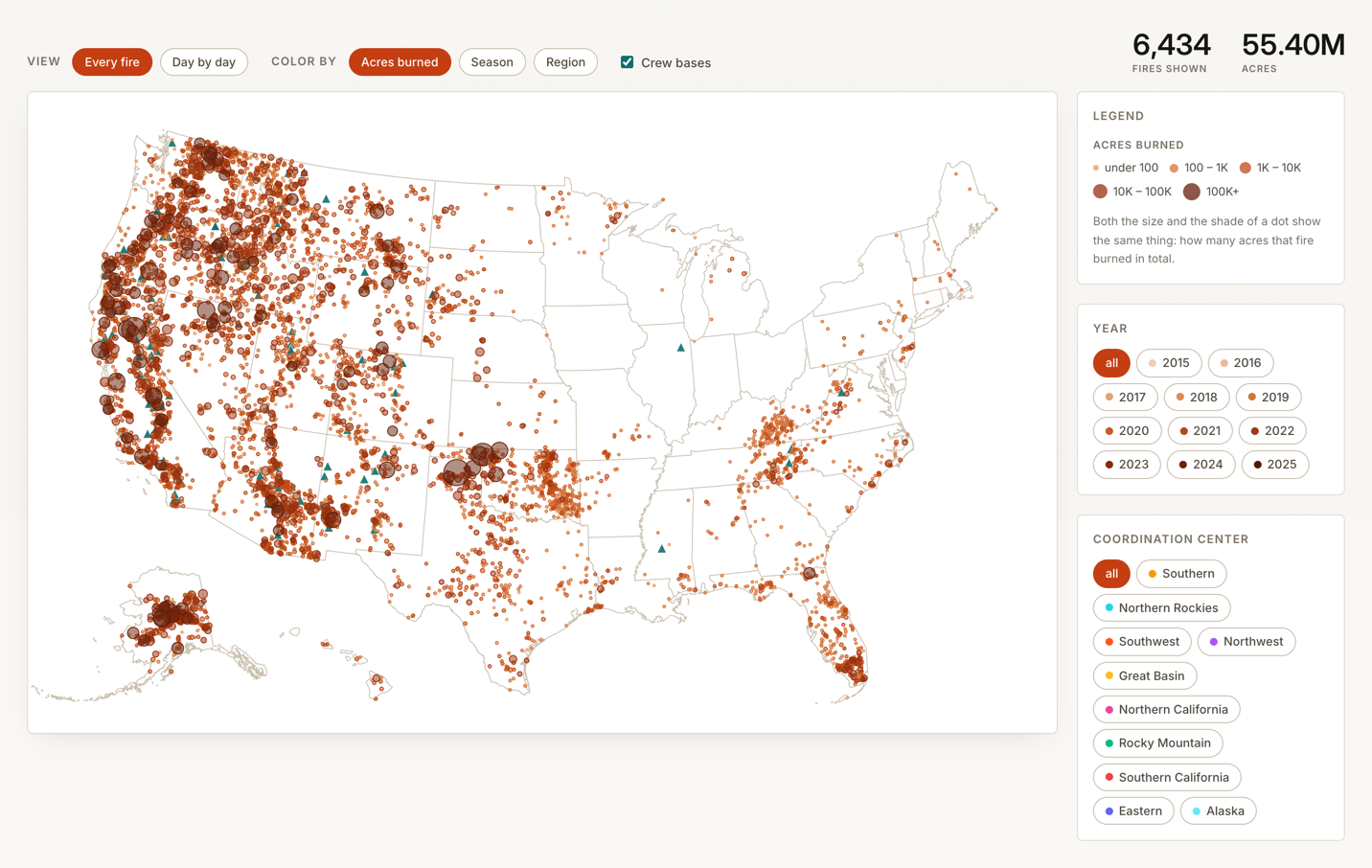
Every wildfire in the study: 6,434 incidents between 2015 and 2025, totalling 55.4 million burned acres, each placed at its point of origin and sized by final area. Triangles mark hotshot crew bases. Alaska appears on the map but was excluded from the allocation experiments, which cover the contiguous United States.
Two years of research, one homework assignment
That emphasis on making technical work visible and testable carries directly into Boussioux’s classroom in Foster’s Master of Science in Information Systems program.
“Make your work public, test it, visualize it,” he tells his students. But he also wants them to learn how to tackle problems that reach beyond their own technical expertise.
The wildfire research offers a striking example. Boussioux spent roughly two years developing the project with colleagues whose optimization expertise complemented his own background in machine learning. Now he plans to give his students a version of the same optimization problem.
He won’t ask them to re-create two years of original research. Boussioux will provide the students with the problem formulation he and his co-authors developed over the course of the project. What has changed is the technology: He says today’s AI models can apply optimization methods his students have never studied, allowing them to tackle technical work that would otherwise be far beyond their training.
“”We spent two years to figure out the complex pieces to combine optimization and machine learning for this problem,” he says. “But basically, as a homework assignment, I can now give students a way into that same hard problem. AI can handle the heaviest technical lifting, including PhD-level math and modeling, but they still have to ask the right questions, guide it, go learn methods they never studied, and execute.”
The lesson is not simply to hand the problem to AI. Boussioux wants students to learn how to direct the technology and, just as importantly, how to determine whether its answer makes sense.
That mirrors how he increasingly works himself. Boussioux sometimes asks AI to solve optimization problems even when he doesn’t know which method it will use. Rather than trying to inspect every step, he checks key properties of the solution and asks targeted questions.
He compares the process to managing a team: You can’t check every detail of everyone’s work, but you still need to know what questions to ask and how to judge the result.
“We can launch AI at hard problems,” Boussioux says, “but you need to properly direct it.”
This research was conducted with MIT collaborators Alexandre Jacquillat, Ryne Reger, and Jacob Wachspress. Read the full paper, “Predictive and Prescriptive AI toward Optimizing Wildfire Suppression,” at arxiv.org/abs/2605.04510.