

You walk into a casino. Next to the roulette wheel, a digital display shows the last 20 numbers that have come up. Red, black, 17, 22, 35—the history is all there, flashing in real time. You feel armed with information, ready to place a smarter bet.
There’s just one problem: On a fair roulette wheel, those numbers are entirely meaningless.
Casinos learned a long time ago that showing people more information, even if it is objectively useless, gets them to bet more. And when people bet more, the house wins more.
This same dynamic might be playing out in contexts far beyond casino floors, from racetracks to stock markets. That’s the unsettling insight from recent research by Foster School of Business Associate Professor of Accounting Darren Bernard and his co-authors. They discovered that providing people with more public information can actually make them worse off—not because they make worse predictions, but because they become overconfident about their edge.
When everyone gets smarter, nobody wins
Darren Bernard’s research started in an unlikely place: spending afternoons with his cousin watching horse races. As a PhD student at Foster in 2014, Bernard found himself staring at the Daily Racing Form—the newspaper that serves as the disclosure mechanism for horse racing—and something clicked.
“I began to learn about all the different components, and at some point, I started connecting the dots between what I study, which is public disclosure, and the fact that here you have a periodical covering all the horse races in the country that includes this set of information,” Bernard explains.
He learned that a number running down the center of the racing form had only been introduced in the early 1990s. Called the Beyer Speed Figure, it quantifies a horse’s performance in any given race, making it easier for bettors to compare horses across different tracks and conditions. This presented a rare opportunity for Bernard to study what happens when everyone suddenly gets access to the same new piece of data.
The better-than-average trap
Bernard and his co-authors—Karthik Balakrishnan, Kristina Rennekamp, and Blake Steenhoven—discovered that when the Beyer Speed Figure was introduced, something counterintuitive happened: people bet more money, which meant they lost more money.
The speed figure itself was genuinely helpful information. It predicted which horses were more likely to win. But here’s the catch: In parimutuel betting, where the house takes a fixed percentage of every bet, having good information only helps if you’re better at using it than everyone else.
“The same thing holds with public information,” Bernard says. “You give 100 people additional information, and people, on average, are going to think they’re better.”
This is what psychologists call the “better-than-average effect”—the same phenomenon that leads 90 out of 100 Americans to claim they’re above-average drivers, even though, as Bernard puts it, “that math doesn’t math.”
The research team wasn’t initially certain this was the mechanism at work. To nail it down, they brought in experimental psychologists Rennekamp and Steenhoven, who designed a clever lab experiment using trivia questions. They gave participants what seemed like an advantage—removing two wrong answers from multiple-choice questions—but structured the payoffs so that you only got paid if you performed better than average.
The results mirrored the racetrack findings almost perfectly. People became more confident and wagered more, even though their actual performance didn’t improve. They just thought they had an edge.
With the mechanism confirmed, Bernard’s team turned back to the racetrack data to understand when bettors were most susceptible to this overconfidence trap.
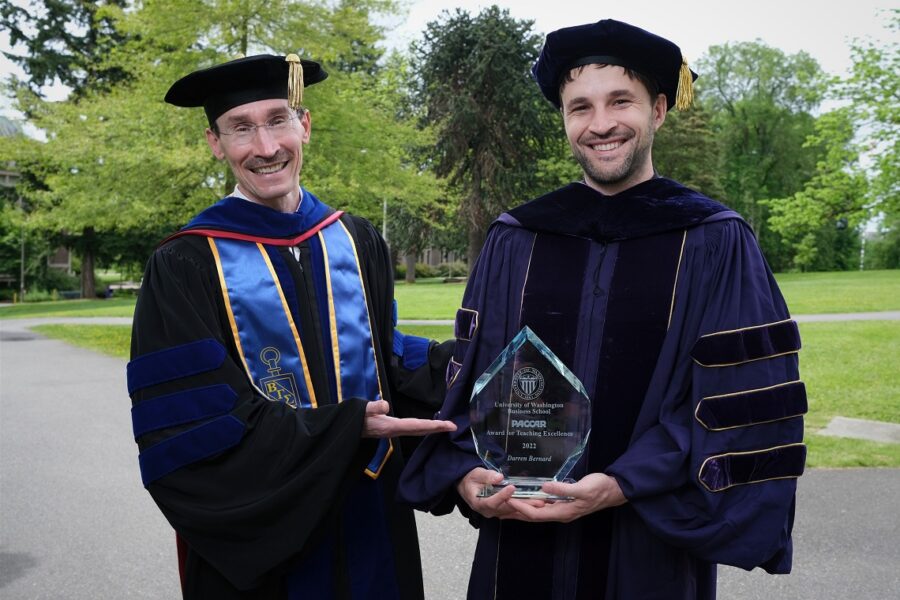
Darren Bernard received the PACCAR Award for Excellence in Teaching, as selected by Foster MBAs, in 2022 for his exhaustively prepared and extraordinarily inclusive learning experience. Bernard (left) is pictured here with Dean Frank Hodge.
Weekend warriors and weekday pros
The pattern was striking: The effect was concentrated on weekends, when casual bettors showed up at the track for a fun day out.
“If you’re opening up the form and you see this number, you’re much more likely to just naively use it,” Bernard explains, “versus somebody there during the week who has their own established system and is a little bit better calibrated.”
This pattern suggests that less sophisticated participants are most vulnerable to overconfidence when presented with public information. They don’t yet understand that when everyone has access to the same data, the odds adjust accordingly, and that having information isn’t the same as having an advantage.
The effect did dissipate after about two years. Bernard’s interpretation: “They see their bank account draining even faster than it was before, and so people eventually start pulling back on it.”
From horse racing to Robinhood
Bernard chose horse racing because it offered a clean, natural experiment, but his real concern is with equity markets, particularly the explosion of retail trading through apps like Robinhood.
“There’s this perception that more information is better—if you want to protect people, you give them more information,” Bernard says. “I think it’s important to caveat that a little bit. What you can do by giving people more information, if they suffer from the better-than-average effect, is that they might actually trade more, not less. And ultimately, what we know from the literature is that retail traders tend to do worse.”
The implications are uncomfortable for regulators like the SEC, which prides itself on creating transparent financial markets. Bernard’s research suggests that transparency, while generally valuable, isn’t a cure-all. In some contexts, more public disclosure might actually hurt the very people it’s designed to protect.
“Maybe when we have these conversations about what the SEC should do to protect retail investors, the answer is not: more information, more information, more information,” Bernard argues. “In fact, that could actually have adverse consequences.”
research A decade in the making
Getting to these findings required an epic 11-year journey from initial idea to publication—one that almost didn’t have a happy ending. Bernard collected data by hand from deteriorating newspapers provided by a racetrack enthusiast named George, who worked at the newsstand in Pike Place Market. When he realized he needed comprehensive betting data from the early 1990s, he flew from London, where he was teaching at London Business School, to Lexington, Kentucky, where a librarian helped him unearth boxes of microfiche from a museum basement.
Converting 250,000 pages of microfiche to machine-readable data required a specialized company in London. When optical character recognition technology failed, the research team contracted with a data processing service in India to manually input the numbers, one race at a time.
Even after finding significant results, the paper took more than four years from submission to acceptance. At one point, Bernard told his co-authors he wouldn’t work on it again if it got rejected.
He laughs about it now. “The pain is all behind me,” he says. When asked if there’s a part of him that wishes the question had never come to his brain, he quotes the concept of a Pyrrhic victory—a win that comes at such devastating cost that it’s tantamount to defeat.
Then again, he’s quick to add that he’s gotten much better at picking horses. “I’m not withdrawing anymore at the ATM,” he says. “But no, I’m not retiring anytime soon.”
Which is excellent news for Foster students. In 2022, MBA students chose Bernard to receive the PACCAR Award for Excellence in Teaching, the Foster School’s highest teaching honor. He’s known for starting every accounting class by playing a classic hit, creating diverse and inclusive case studies, and demonstrating that he genuinely cares about his students. The same curiosity and rigor that drove him to spend 11 years chasing down an answer from the racetrack shows up in every lecture, where future business leaders learn to think more critically about the information they’re given.
The takeaway from his research isn’t that information is bad or that markets should be less transparent. It’s that disclosure is a tool, not a panacea. Like any tool, its effects depend on how it is used.
“I think it’s important for people to think carefully about transparency,” Bernard says. “I fully believe that transparency can have really positive effects. But sometimes the opposite can be true, too.”
When everyone gets access to the same information, feeling informed and being advantaged are two very different things. And in markets where the house always takes its cut, that distinction makes all the difference.
Read the research: “Public Information, Relative Overconfidence, and Capital Flows”—Karthik Balakrishnan, Darren Bernard, Kristina Rennekamp, and Blake Steenhoven. Published in Journal of Accounting Research (2025).