

Some economists trace their interests to a book or a favorite class. For Vladimir Dashkeev, a newly appointed Assistant Teaching Professor at the University of Washington’s Foster School of Business, the spark came much earlier, shaped by living through one of the most dramatic economic transitions of the 20th century. Growing up in the former Soviet Union, he witnessed the sudden collapse of a system that many adults around him had long believed was stable—and watched as his grandparents’ retirement savings evaporated almost overnight.
“That experience shaped everything,” he says. “I wanted to understand why those shifts happened and what could be done to prevent similar outcomes elsewhere.”
Today, Dashkeev channels that early curiosity into research and teaching that make macroeconomics feel both urgent and accessible. His work bridges fiscal policy, monetary systems, and financial technology, with a particular interest in how open economies and central bank digital currencies (CBDCs) shape macroeconomic outcomes.
From Moscow think tank to UW scholar
Dashkeev spent several years as a research fellow at the Gaidar Institute for Economic Policy, working alongside Yegor Gaidar—Russia’s acting prime minister during a pivotal period in the country’s transition to a market economy. The experience offered rare insight into how policymakers navigate economic shocks and unpopular reforms.
That foundation ultimately led him to pursue a PhD at the University of Washington, where he studied how regional governments manage budgets and policies, and began teaching. After a faculty appointment at Seattle University, he has now returned to the Foster School of Business and the Department of Finance and Business Economics.
The return felt full circle: an academic journey shaped by global transitions, institutional insight, and a growing passion for teaching. “When the opportunity came to join Foster, it was amazing,” he says. “I studied here, I taught here as a PhD student, and now I get to contribute as a faculty member.”
Research at the frontier of fintech
Much of Dashkeev’s current research uses dynamic stochastic general equilibrium (DSGE) models to examine one of the most debated innovations in modern monetary policy: central bank digital currencies.
“It’s incredibly dynamic,” he says. “Central banks fear missing out. If they don’t begin experimenting with digital currencies now, they worry they’ll never catch up.”
He studies both the promise and the risks. CBDCs could make fiscal and monetary policy more precise and more efficient. But substituting cash with digital currency raises profound questions about privacy, inclusion, and the safeguards needed to prevent misuse.
“Monetary policy could become much more efficient,” he explains. “But if central banks have full visibility into transactions, how close are we getting to an authoritarian regime? The tools are almost there. The question becomes: how benevolent are the policymakers?”
He is especially interested in how societies weigh the benefits of innovation against the intangible costs of reduced privacy, and how global differences in political culture shape that balance.
“This topic won’t stop evolving,” he says. “Technology moves quickly. An answer that feels right today could be outdated in six months.”
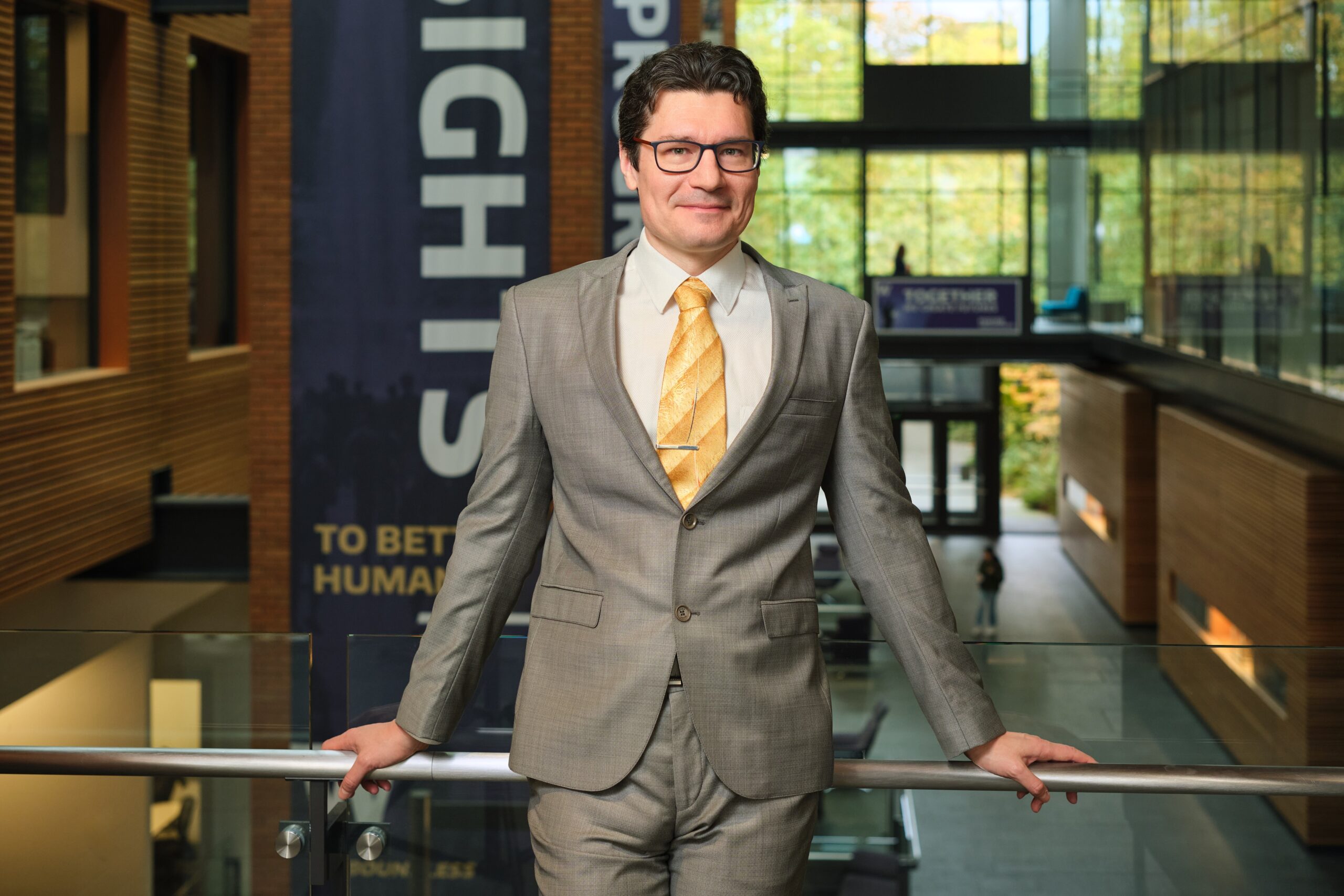
Vladimir Dashkeev, Assistant Teaching Professor at the University of Washington’s Foster School of Business, brings a global perspective to macroeconomics shaped by lived experience and policy research.
vladimir dashkeev on Teaching with curiosity and candor
Walk into Dashkeev’s Macroeconomics or Microeconomics classroom, and you’ll find a space built on questions—often unexpected ones.
While his research tackles big-picture questions, Dashkeev’s classroom is where he sees economic thinking come to life. He teaches with a practical, data-driven approach, rooting theory in current events, policy debates, and everyday decision-making.
“I’m grateful to my students,” he says. “They ask questions textbooks never cover. They force me to make connections across different fields.”
Those “aha” moments often emerge from simple concepts. One of his favorite examples is the law of diminishing marginal returns, which he illustrates not only through production functions or national growth patterns, but through exam-week study habits.
“When students come to an exam with red eyes, I tell them that this is the law of diminishing returns,” he laughs. “If you study gradually, you retain more. If you pull an all-nighter, your marginal learning collapses to zero.”
He hopes students leave his classes with more than content mastery. What matters most to him is how they think.
“I want them to feel comfortable making mistakes,” he says. “If you’re making mistakes, it means you’re thinking. And when you work through the logic together, the correct insights stay with you because you earned them.”
A life beyond models and policy debates
Outside of economics, Dashkeev turns to music and the outdoors to recharge. Coming from a family of musicians, he has a lifelong appreciation of classical music and frequents Seattle’s Benaroya Hall (home of the Seattle Symphony) and McCaw Hall (home of Seattle Opera and Pacific Northwest Ballet).
He’s also an avid hiker, often heading to Tiger Mountain for quick, energizing workouts and to Mount Rainier’s Skyline Trail for longer, scenic escapes.
“When autumn hits and everything is green and yellow and orange, it’s just gorgeous,” he says. “Those hikes help me reset.”
Looking ahead
At Foster, Dashkeev hopes to continue bridging the worlds of research and teaching. He aims to bring clarity to complex systems, help students see the real-world implications of theory, and cultivate the curiosity that first drew him to economics.
“We’re past the era when research lives in an ivory tower,” he says. “Today, the goal is to answer real questions that matter for governments, companies, and individuals. And the classroom is where students learn to think about those questions in new ways.”
Learn more about Foster’s Department of Finance and Business Economics.