

Pull out your phone. Is it an iPhone or an Android? Now, do you know where it came from?
Most people know where they bought their phone, but not where it was made or where its components originated. Behind the device in your pocket is a global network of raw materials, manufacturers, and transportation systems working together to get it into your hands. It’s a supply chain story that most of us rarely think about or see, even as we rely on it every day.
Apurva Jain, Associate Professor of Operations Management at the Foster School of Business, describes supply chains as the “behind-the-scenes magic” that gets people what they want, when they want it, at a reasonable price and in the quantity they need. He has taught supply chain at the Foster School for more than 25 years and serves as faculty director of the Master of Supply Chain Management program.
Jain’s research focuses on information sharing and collaborative decision-making in the grocery supply chain. He teaches in the Evening MBA program, where students bring professional experience from a range of industries into the classroom.
For Jain, supply chain education has taken on new urgency in classroom discussions. Artificial intelligence (AI) is changing how work gets done, while geopolitical tensions and climate change are raising questions about how goods such as diesel and fertilizers move around the world. We sat down with Jain to understand not only how those systems work, but how to think through decisions when the conditions a company relies on begin to change.
When business as usual no longer works
When supply chains work well, they’re easy to overlook. But when something goes wrong, the effects are hard to miss. During the COVID-19 pandemic, the disappearance of toilet paper from store shelves illustrated how quickly everyday routines can be disrupted. When an airline cannot secure the fuel or aircraft parts it needs, flights (and therefore, vacations) get canceled.
For all businesses, a supply chain disruption can mean lost sales and lost opportunities, and customers who take their business elsewhere. Jain says these disruptions highlight the challenge organizations ranging from hospitals to grocery stores face when circumstances change faster than expected.
“With all the geopolitical changes and trade wars, everything is shifting. There’s so much uncertainty right now, which people don’t like because we want things to be stable and predictable,” Jain says.
These challenges affect professionals well beyond supply chain departments. A decision about sourcing materials might affect production costs (resulting in higher prices at checkout), while a shortage of parts can disrupt an entire operation, delaying shipments. As AI changes how work gets done and global events reshape how goods move, professionals need to understand how decisions in one part of a business can affect the rest of the business.
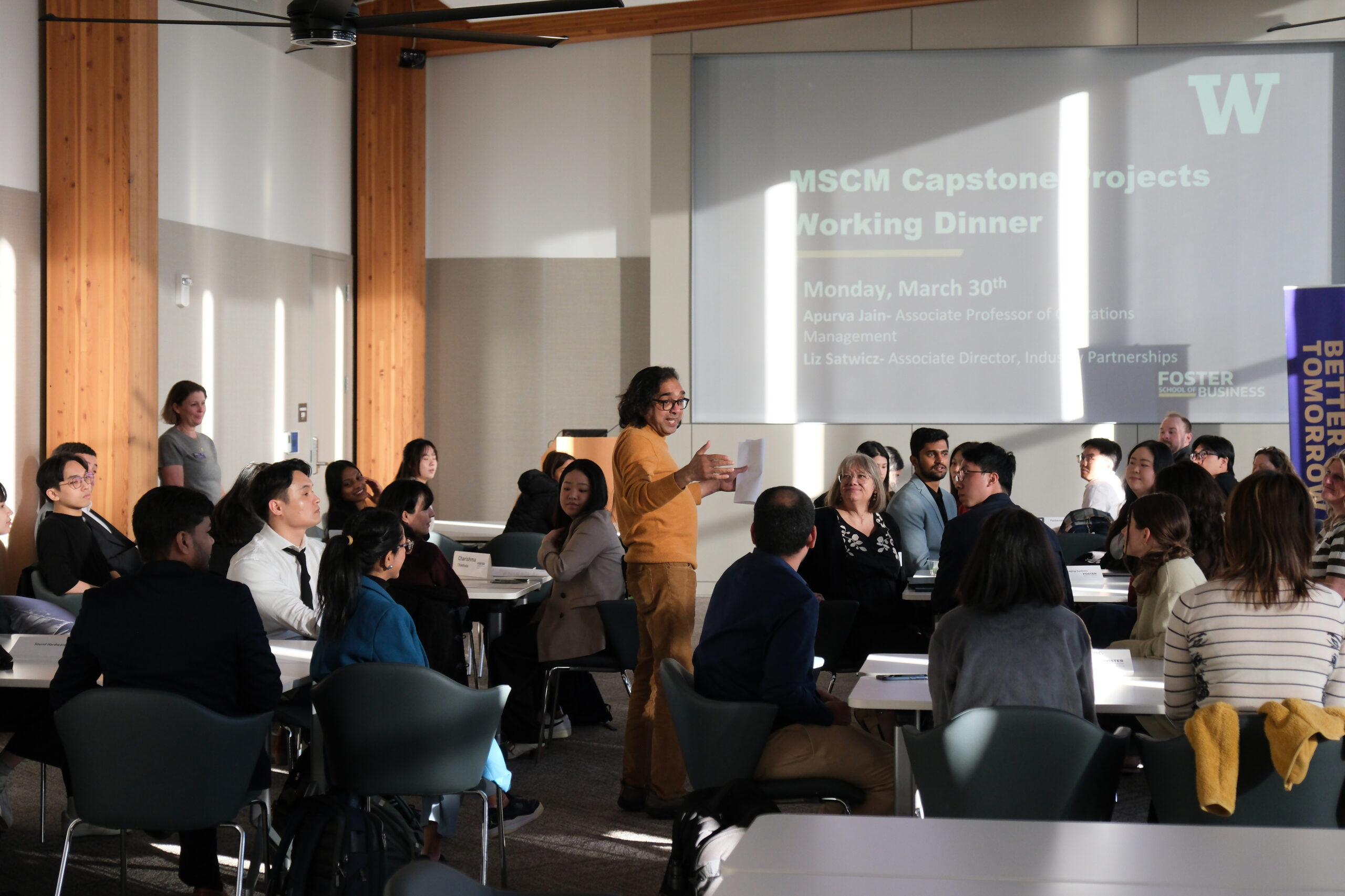
Rethinking business as usual: Apurva Jain challenges students to look beyond traditional supply chains, question established practices and find smarter ways to solve complex business problems in an unpredictable world.
Supply chain is everywhere
Jain’s students arrive with professional experience across industries and functions. They know what it means when a process breaks down, or how a decision in one department can create problems for another. Those experiences give the class a starting point for exploring business challenges from different perspectives.
“It’s a very interesting time of two-way learning,” Jain says. “Students are contributing as much to this current moment of learning as they are seeing it appear in their working lives. The exchange goes both ways.”
That exchange matters in a business environment where “best practices” can quickly become outdated. Students can test what they’re learning against the challenges they face at work, while their classmates bring different experiences and approaches to the same questions.
Jain also wants students to recognize how widely the thinking behind supply chain management applies.
“I want students to realize that supply chain is not just operations,” Jain says. “Supply chain workflow is everywhere. And what we really want to do is give students a skill set that allows them to think about how to do things better in whatever context that may be.”
A central concept in his teaching is continuous process improvement. Whether someone works in manufacturing, government, technology or retail, Jain says, the underlying skill is learning to examine how work gets done and identify where a process could be better.
“And better is either faster, more efficient, higher quality, or cheaper,” he says.
But, finding a possible improvement is only the first step. Business professionals also need to weigh the trade-offs before deciding whether a proposed change is worth making.
“It’s not enough to have an idea,” Jain says. “You have to ask, ‘Is it worth it? How is this going to change things? Can I make a cost-benefit case on that?’”
For his students, that kind of analysis directly connects classroom learning with the decisions they make at work every day.
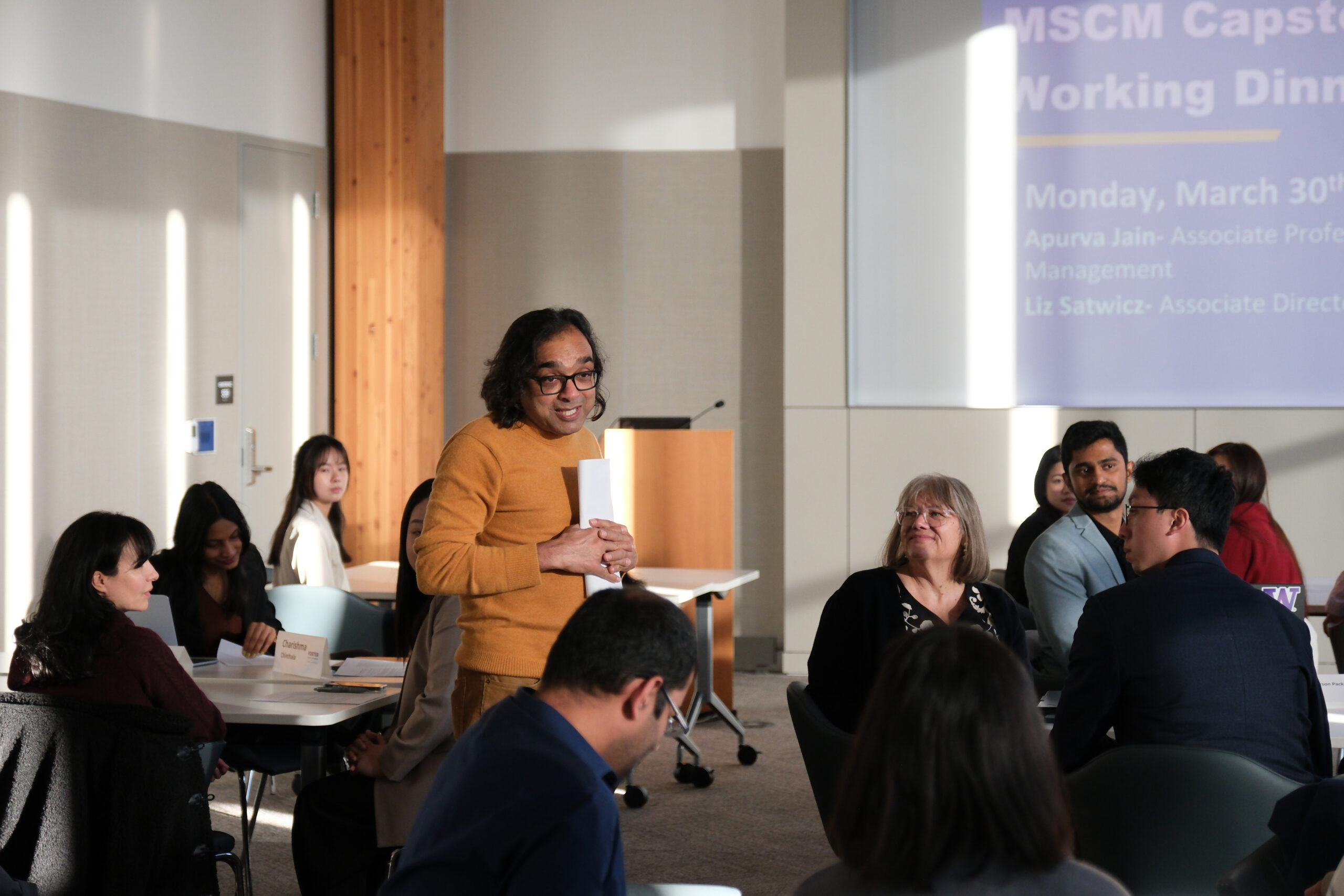
“Supply chain workflow is everywhere. What we really want to do is give students a skill set that allows them to think about how to do things better in whatever context it may be.”—Apurva Jain
Preparing for an UNpredictable business world
Many businesses have spent decades refining their supply chains to make them more efficient, and many of these supply chains have operated largely out of sight. But geopolitical tensions and climate change are raising new questions about how reliable these systems are.
“There is a new terrain in business now,” he says. “I don’t know where our next iPhone will come from over the next 10 years. We don’t know how the climate will affect the supply chain nodes, or how geopolitics and trade wars will influence them.”
The uncertainty presents real challenges for business leaders, but Jain sees it as an opportunity for professionals willing to rethink established ways of thinking.
“If you’re the type of person who thinks that change is opportunity, then this is a super interesting time for supply chain,” Jain says. “As the supply chain landscape continues to transform, business leaders will need to be more nimble and develop faster reactions to what is changing, using the models and software tools that we use in class.”
Whether they’re helping an airline secure enough jet fuel to keep flying or a retailer figuring out how to keep fresh flowers in stock during Valentine’s Day, professionals need to make sound decisions with incomplete information and adapt as circumstances change. Jain’s classroom helps students build that judgment and respond when “business as usual” is no longer an option.
Learn more about the Evening MBA program at the Foster School of Business.