

A psychology major. A communication major. A computer science major. A business major.
At most universities, they might never meet. But through the Foster School of Business entrepreneurship minor and the Arthur W. Buerk Center for Entrepreneurship, they spent two quarters building a company together.
The company is Lumière, which makes hand-poured candles inspired by the cultures, memories, and experiences of its founders: Rhea Wanga, a psychology major; Jehan Hashi, a communication major; Aditi Rana, a computer science major; and Mia Pino, a marketing and entrepreneurship major.
But for the four founders, the candles are only part of the story. The bigger lesson came from learning how to build a viable business.
unlocking options with an entrepreneurship minor
Through Foster’s entrepreneurship minor, which is open to all undergraduates at the University of Washington, students learn hands-on entrepreneurship. One of the program’s signature offerings is Creating a Company, an experiential learning two-quarter course in which student teams identify opportunities, conduct customer research, launch businesses, and run a real company.
The Lumière team spent its two quarters transforming an idea into a functioning business. While building leadership skills, they learned that entrepreneurship is different in practice than in theory.
Hashi quickly discovered that building a company required a different kind of learning than most classes.
“The pressure is on to generate a profit, but that’s how you learn to run a real business,” she says. “Experiential learning [like Creating a Company] enriches a college education. It provides the chance to grow as a thinker, spark meaningful connections, and build diverse skill sets.”
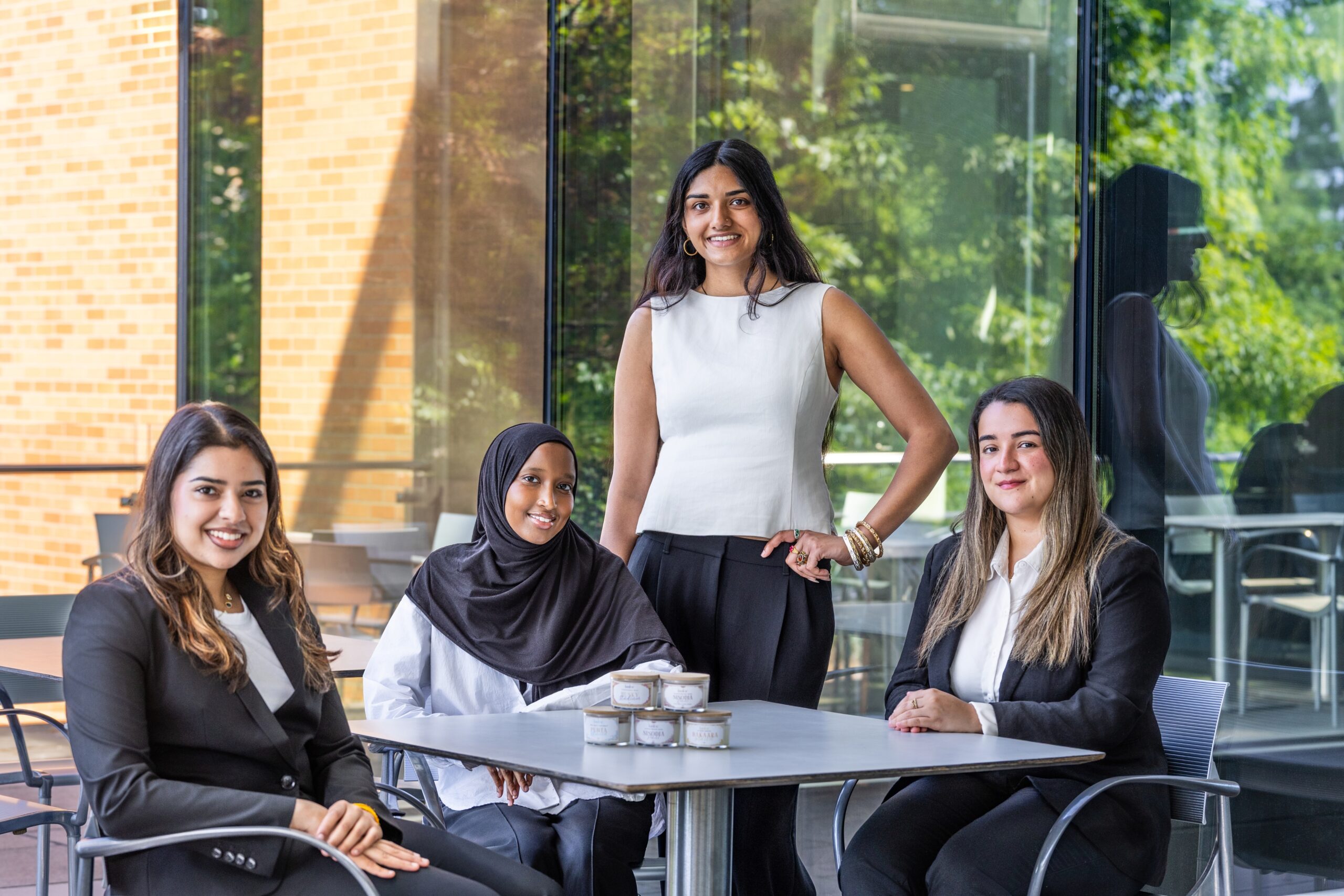
Members of the Lumière team gather in the PACCAR Building before presenting the final results of their company in Foster’s Creating a Company course. From left, Rhea Wanga, Jehan Hashi, Aditi Rana, and Mia Pino.
Identifying actionable market opportunities
At the beginning of the first quarter, the team was convinced they had the perfect idea: a skincare product. They started imagining what the company might become. Then, the instructor, Lisa Hjorten, challenged them to reconsider.
The concept posed hurdles that were difficult to overcome within the constraints of the course. It forced the students to confront a reality most entrepreneurs eventually face: sometimes, the idea you love isn’t the one you pursue.
“When our professor came to us saying that our skincare-mist idea had too many logistical and legal aspects to worry about, we were scared about how we were going to pivot,” says Rana. “We had been a little too locked in and in love with our initial idea that we didn’t really know anything else that felt right.”
For Hashi, that unpredictability was challenging: “As someone who strongly dislikes uncertainty, I had a period of nervousness about what my future in the course would look like,” she says.
The setback became an early lesson in adaptability. Rather than directing the team toward a solution, Hjorten encouraged them to seek advice from mentors, teaching assistants, and industry professionals, then use that information to make their own decisions. Rana says one piece of guidance from Hjorten stayed with her throughout the quarter.
“Professor Hjorten really emphasized this point: she always says to ask for advice, not feedback,” Rana recalls. “Advice is where people will tell you how you should actually go out and make the next improvement, and it leads them to provide honest, constructive criticism.”
The team took that approach seriously. Eventually, they landed on an idea that felt both practical and personal: hand-poured candles inspired by their own cultures and memories. That business would become a lesson in customer discovery.
Looking back, Rana says the experience taught her that entrepreneurship requires a willingness to let go of certainty.
“Being stubborn and too in love with what you think is right, and not taking in feedback, will only hurt you hard and fast,” she says. “Having an open mind and willingness to try new things, and then perhaps fail at them, and then adapt based on those mistakes, is the best way to truly cultivate a successful business.”

From customer discovery to final presentations, students in Creating a Company experience the challenges and rewards of entrepreneurship firsthand. From left, Mia Pino, Aditi Rana, Jehan Hashi, and Rhea Wanga
A mission inspired by childhood memories
As the students explored what they wanted Lumière to represent, they realized they shared something deeper than a business concept. They wanted to create a company that reflected their identities and the communities that shaped them. Their mission became: “A story in every scent.”
The result was a collection of candles inspired by India, Ecuador, and Somalia.
Hashi, who grew up in Burien outside Seattle, drew on childhood memories of Somali markets filled with conversation and community gatherings to develop the Citrus Agave candle.
“When I was younger, we would go to Halal markets that were filled with members of the Somali community gathering, enjoying fruits and chatting,” Hashi shares.
Pino, an international student from Ecuador, found inspiration in beach days along Ecuador’s coast and coconut ice cream shared with family. That memory became Sea Salt Coconut.
“I wanted to capture the essence of an Ecuadorian beach in a candle,” she says.
Wanga found inspiration in scents that immediately reminded her of her childhood home in India. She remembers temple visits filled with sandalwood incense and afternoons spent playing in rose gardens.
“If you were to ask any Indian person the two staples in the house, it would be sandalwood and rose,” she says.
For Rana, the same scent carried a different meaning. While Wanga associated sandalwood with specific childhood memories, Rana saw it as a symbol of spirituality, family traditions, and a broader connection to her Indian heritage.
Those memories became Sandalwood Rose. And, their different perspectives reinforced one of the team’s biggest discoveries: even the same scent can tell different stories.
“People were not just buying a candle; they were connecting with the stories behind it,” Wanga explains.
going beyond product development
“The most valuable thing I learned from building a real business through this course is that a concept often sells better than a product itself,” she says. “Customers are not simply buying a candle; they are buying the experience, emotions and meaning behind it.”
Hashi saw that connection firsthand as she shared Lumière’s story with customers and followers.
“My excitement for my company made it significantly easier to sell our candles,” she says.
Most importantly, she says, the experience reinforced her appreciation for community and cultural storytelling.
That realization became one of the course’s most important lessons: Entrepreneurship isn’t only about creating a product. It’s about understanding customers, testing assumptions, and adapting based on market signals.
For Wanga, those lessons changed the way she thinks about entrepreneurship itself.
“The best products are not built for customers; they are built with customers,” she says. “Through customer discovery and selling our candles, I learned that customers need to be part of the process. Their feedback helped shape our products and some of our biggest decisions.”

The entrepreneurship minor helps students move from imagining possibilities to creating them. By building and operating real ventures, students gain the experience and confidence to pursue new opportunities long after graduation. From left, Rhea Wanga, Aditi Rana, Mia Pino, and Jehan Hashi
Where different perspectives become shared strengths
Drawing students from across the University of Washington, the entrepreneurship minor brings together different perspectives and skill sets. Lumière reflected that diversity.
The Creating a Company class also revealed a broader aspect of interdisciplinary education: the students spent two quarters learning skills they might never encounter in their own majors. Wanga led customer discovery and product development; Hashi spearheaded advertising and outreach; Rana managed finance and supply chain operations; and Pino served as CEO.
As the course progressed, those roles overlapped. Each student stepped in to help wherever needed.
“One of the biggest lessons I learned about teamwork through this experience was the importance of trusting each other’s strengths and being flexible when challenges arose,” Pino says. “There were also times when we had to step outside our usual roles and support one another to make sure everything came together successfully.”
Confidence you can’t learn in a textbook
“This experience was completely different from a traditional classroom because every decision had real consequences,” Wanga says. “The biggest skill I gained was confidence. Over the two quarters, I became much more comfortable speaking with customers, presenting ideas, and handling rejection.”
“Initially, it was very challenging to sell to customers,” Hashi adds. “I was nervous about rejection and the pressure to have a strong sales pitch. For example, one of our first tabling events was at the University Bookstore student pop-up. We sat at the table watching customers walk in, too nervous to grab their attention. However, the few customers who stopped by showed genuine interest in our mission and products. This instilled confidence in me to try new sales techniques and connect with as many customers as I could. Getting over this barrier transformed our sales revenue and strengthened my communication skills immensely.”
For Rana, the class stands apart from any other course she has taken at the University of Washington.
“Creating a Company is the best class I’ve taken at the University of Washington,” she concludes. “The format of the course made what we were learning fun and engaging, and every day I could see how the skills and lessons I was learning from running Lumière would be something I would take and apply in the future.”
When classroom concepts enter the real world
Not every student who completes Foster’s entrepreneurship minor will become an entrepreneur after graduation. But that isn’t the point. The course gives students the opportunity to discover what they’re capable of when classroom concepts become real-world decisions.
For Hashi, the experience expanded her understanding of what entrepreneurship could be.
“I applied to the entrepreneurship minor without a clear idea of what company I’d like to start,” she says. “Through Lumière, I discovered how much I enjoy connecting with communities and sharing stories that matter.”
As Wanga reflected on the experience, she returned to a lesson that began as an interest and ended as a possibility: “This two-quarter class turned entrepreneurship from something I was interested in into something I genuinely believe I can do in the future.”
Many thanks to students Jehan Hashi, Mia Pino, Aditi Rana, and Rhea Wanga for sharing their experiences in the Foster School of Business Entrepreneurship Minor, and congratulations on your success with Lumière.