

In 2018, the U.S. Supreme Court struck down the federal ban on sports betting, allowing individual states to decide whether to legalize it. Within just a few years, 30 states plus Washington, DC, had adopted online sports gambling.
The pitch from industry lobbyists in favor of legalization was compelling: Online sports betting could generate new tax revenue. However, research by Uttara Ananthakrishnan, Assistant Professor of Information Systems at the University of Washington’s Foster School of Business, reveals that online sports gambling isn’t generating entirely new revenue—it’s largely cannibalizing existing lottery sales.
Online sports gambling and the decline in lottery revenue
Ananthakrishnan, along with co-authors Poet Larsen (Harvard Business School) and Sriniketh Vijayaraghavan (Texas A&M), analyzed lottery sales data from 18 states and Washington, D.C., and transaction-level data from 80% of all independent convenience stores nationwide. They found that lottery sales declined by roughly 5% on average in the 16 months following the introduction of online sports gambling. They present their findings in a working paper titled “Cross-Channel Demand for Addictive Goods: Evidence from Online Sports Gambling and State Lotteries.”
From a public revenue standpoint, lottery spending is vastly more productive: States capture 25 cents of every dollar spent on lottery tickets, compared to less than 1 cent from sports betting. This disparity is significant because both revenue streams fund the same critical state programs: education, scholarships, and veteran services.
To isolate the effect, the researchers compared convenience stores just a few miles apart along the Washington-Oregon border. The stores are in similar neighborhoods with similar demographics, the only difference being that Oregon had legalized online sports gambling. Oregon stores experienced a decline in lottery sales, while Washington stores did not.
Ananthakrishnan explains that “people have to spend 30 times more on sports gambling” to generate equivalent state revenue. Among the states they studied, the 5% decline in lottery sales translated to $164 million in lottery revenue over 16 months that shifted away from these high-return programs. Just 43% of sportsbook tax revenue represents truly new money. The other 57% would have been generated through lottery sales had demand not shifted.
So while states are collecting more tax revenue overall, most of it isn’t new money. It’s simply replacing lottery revenue that would have been collected anyway, while generating expensive downstream costs.
The hidden fiscal and social costs of sports betting
The shift from lottery to sports betting also brings downstream costs. Gambling helplines have seen dramatic spikes; one in New Jersey reported a 200-300% increase in calls after legalization. Ananthakrishnan’s ongoing research is also documenting increases in crime, particularly auto theft and petty larceny, in the years following sports gambling legalization.
“You’re financially troubled, you don’t have money to gamble, now you have debt,” she explains. “Those are the downstream consequences. Any form of addiction comes back and bites people.”
Ananthakrishnan stresses that these harms are not evenly distributed. Most people engage with gambling at the level of a bad habit, not an addiction—but for a smaller, vulnerable group, the consequences can escalate quickly.
The decline in lottery sales primarily came from the heaviest users, known as “whales,” who account for the bulk of lottery purchases. Crucially, this suggests that legalization isn’t simply shifting casual players between products, but is disproportionately affecting the small group of people most vulnerable to problem gambling.
States already struggling with opioid crises may be ill-equipped to handle another wave of behavioral health needs.
“It’s just not worth it for states to legalize sports gambling if the only reason is money,” she says. “You’re basically saying, ‘I want people to be really addicted for me to make money as a state government,’ which will have downstream impacts that will cost a lot more money to solve.”

“People have to spend 30 times more on sports gambling to generate equivalent state revenue.”—Uttara Ananthakrishnan
A personal connection to gambling’s grip
Ananthakrishnan’s interest in gambling was shaped by watching a highly educated family member struggle with addiction.
“It was always fascinating for me to see how someone who was so educated and so intelligent and pretty nice in all other aspects of life could be so into something that was clearly really destructive,” she says.
That family history sparked her broader interest in how people slip from bad habits into harmful relationships with everything from social media to dating apps to gambling. The key difference with online sports gambling is how technology removes barriers. To buy lottery tickets, you have to go in person to a licensed retail store like a gas station. If you feel like buying another ticket, you have to leave the house again. With sports betting, you can place a bet from your couch, then immediately place another, and another.
“Sports gambling is basically gambling on steroids in many ways, mainly because you almost remove all the costs, all the frictions,” she explains. Today, 95% of all sports betting happens through apps like DraftKings and FanDuel. “It’s so much easier these days for people to slide from bad habit into addiction.”
Online sports gambling as technology-enabled overconsumption
Ananthakrishnan sees gambling addiction as part of a broader pattern of technology-enabled overconsumption—one made worse by social isolation.
“I’ve seen how gamblers think,” she says. “There’s this circuit in your head that determines whether you can stop watching a Netflix episode after one and walk away or whether you need to watch the whole season even though you know your next day is completely gone.”
The difference between past generations and today is the absence of social guardrails. She points to the loss of what sociologists call “third places”— community spaces beyond home and work where people naturally gather and look out for one another.
“In every culture, there are always checks and balances that society expects. There are the social and cultural checks that ensure people don’t slip too far into the rabbit hole,” she says.
This isolation, combined with what she calls “choice architecture”—the design decisions that technology companies make to keep users engaged—creates a perfect storm for harmful behavior.
“Don’t blame people, don’t blame technology, blame the architecture,” she says. “You can design out the nudges. It’s so immersive. Everyone thinks they can just stop, and they can’t.”
In a separate study on TikTok and sleep patterns, she found similar dynamics at work: Users getting pulled into endless scrolling sessions late at night, unable to break free from the loop.
The problem extends to college campuses, where some universities partner with FanDuel and DraftKings to promote gambling — part of what a 2022 New York Times investigation termed the “Caesarization” of campuses.
When Ananthakrishnan asks students in her classes how many place bets on DraftKings, 70% of hands go up. Many rationalize it as skill rather than chance. “A lot of them say, ‘This is a game of skill, not a game of luck. We’re smart enough to beat the odds,'” she notes—treating gambling like an investment portfolio rather than what it is.
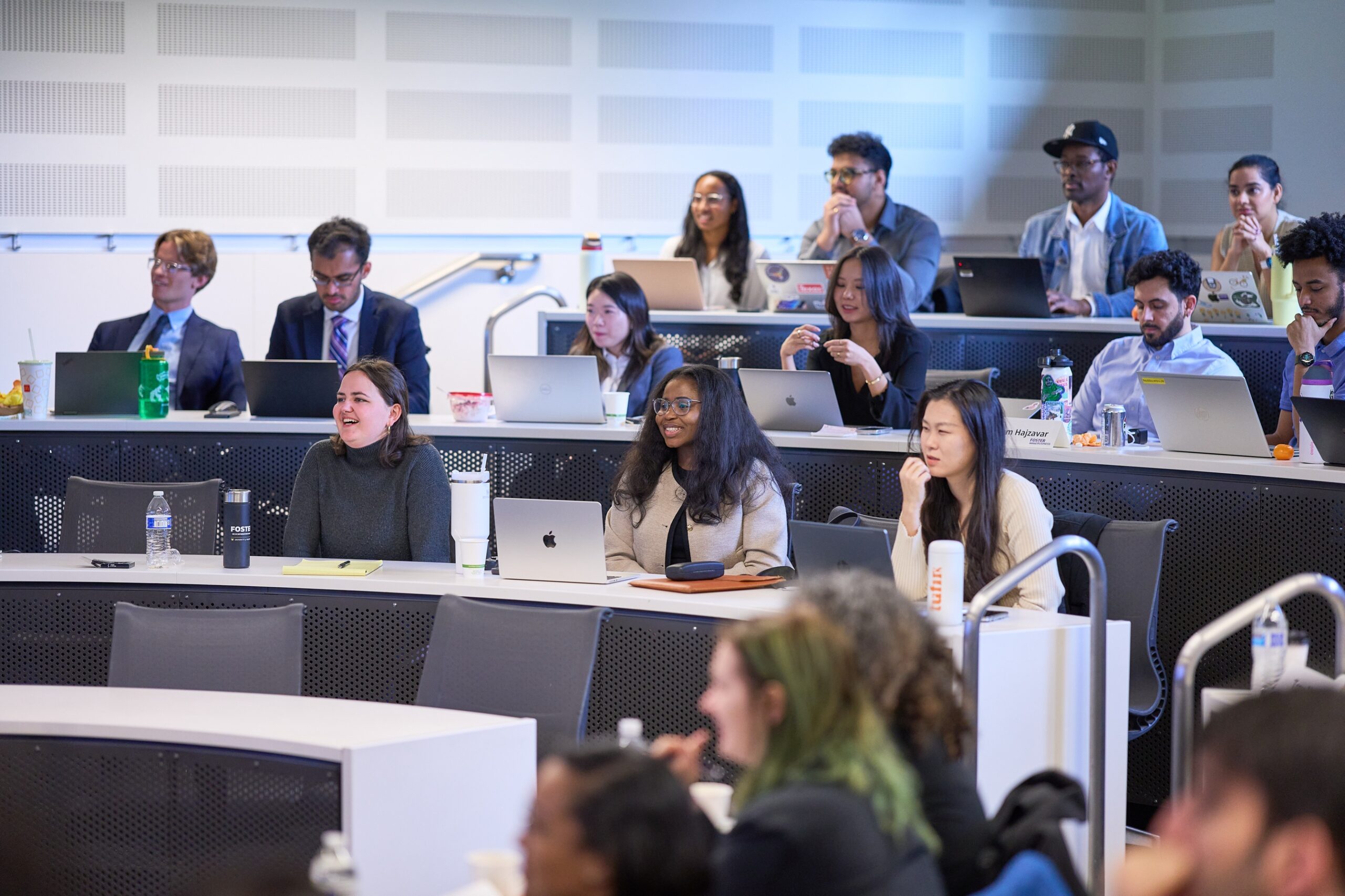
In Foster’s Master of Science in Information Systems (MSIS) program, Uttara Ananthakrishnan emphasizes responsible technology design, encouraging students to consider how product choices can shape user behavior.
Building more responsible technology
Ananthakrishnan’s research suggests solutions that focus on responsible design. Sports betting platforms could implement meaningful friction: requiring users to log in through their bank to place bets, setting firm betting limits, or adding cooling-off periods.
“There are all these design interventions that these platforms can do,” she says.
“I hope they’re developing ways to reduce addiction because states could come in and draw a line,” Ananthakrishnan says. “It’s very difficult to pull people back once they’re very deep into anything. It’s easier to pull them up when they’re sliding.”
These questions drive her approach to teaching product management and digital transformation in the Master of Science in Information Systems (MSIS) program at Foster. She wants to instill in her students a sense of responsibility for the technology they’ll build.
“The students are much more aware of the negative consequences of technology than older generations,” she observes.
But awareness isn’t enough.
“When you’re maximizing engagement, stop and think about the 10% who could potentially over-indulge. How do you stop it?” she asks. “It’s easy to make someone an addict, but it’s very difficult to keep them responsible.”
She’s watched her former students rise quickly in their careers. Six years out, many are already senior product managers—positions where they can shape how millions of people interact with technology. “It’s wild how quickly they can be in positions that actually include tremendous amounts of change,” she says. “This tech ethics part should be a big part of what we teach in business school.”
As AI automates more cognitive tasks, she believes the distinctly human work will be thinking through the consequences of technology. “The rest of it, AI can do now,” she says. “We just need people to think about the good and bad things, which AI cannot really do.”
That might mean advocating for better design within tech companies or entering politics to shape regulations.
“I always tell my students, ‘Get into volunteering or join civic organizations or run for office. Be part of something that’s bigger than you are.'”
Whatever path they choose, she wants them to understand their power—and their responsibility.
Read the full research paper: “Cross-Channel Demand for Addictive Goods: Evidence from Online Sports Gambling and State Lotteries,” by Poet Larsen, Sriniketh Vijayaraghavan, and Uttara M Ananthakrishnan.