

Blue light gets a bad rap when it comes to sleep. We’ve all been told to put away our phones and other screens before bed because the light they emit can keep us awake.
But it’s not the blue light that’s the problem; it’s the timing.
We get blue light naturally from sunlight (it’s actually what makes the sky blue!), as well as from digital devices and artificial lighting. Decades of research have shown that blue light exposure at night can disrupt sleep by pushing our circadian rhythms, or internal sleep-wake clocks, later. Morning exposure, on the other hand, can help us sleep better that night.
Christopher Barnes, the Michael G. Foster Endowed Professor of Management at the University of Washington Foster School of Business, wanted to apply that established science to his longtime field of study: sleep and the workplace.
Barnes had previously shown, with two coauthors, that blue light-blocking glasses worn at night could improve sleep and work outcomes. This time, he and another research team found that blue-light-emitting glasses worn first thing in the morning could help, too.
“This is a pretty small, cheap, easy intervention, and we’re getting meaningful movement on work outcomes that matter,” Barnes says.
The study is part of a broader shift in his research, from documenting the consequences of poor sleep to finding ways to help people get more rest.
From problems to solutions
Barnes’s interest in sleep began during his time in the U.S. Air Force, where he studied fatigue during extended military missions. Later, as a doctoral student in management, he was surprised by how little research had examined the effects of sleep deprivation in the workplace.
He’s since investigated its effects on accidents, creativity, and ethical behavior, as well as how work-related stress can invade our dreams and affect our moods the next morning. (And he’s even researched another bedroom activity that can make for a better day at work.)
After years of studying the effects of poor sleep, Barnes began considering what he wanted to accomplish next.
“I didn’t want to spend a multi-decade career just pointing out the problem without doing anything about the problem,” he says.
The obvious solution would be for employers to stop making demands that interfere with sleep. But Barnes knows that’s a tough sell.
So he’s focused on smaller, inexpensive steps that organizations might be willing to try.
Putting morning light to the test
For this study, Barnes and his coauthors recruited 182 full-time employees at a Midwestern university. For 10 workday mornings, participants wore blue-light-emitting glasses for 30 minutes shortly after waking.
The glasses operated at full intensity for one week and at just 1% intensity for the other. Researchers randomly assigned which week came first, then used daily surveys to compare how each person slept and functioned under the two conditions.
When the glasses operated at full intensity, employees slept an average of about 11 minutes longer per night and reported a 3.5% improvement in sleep quality.
Eleven minutes might not sound like much, but that additional sleep adds up over time. And the benefits extended into the next workday.
Better sleep was associated with greater alertness and less mental exhaustion. Those changes, in turn, were linked to stronger engagement at work, better task performance, more willingness to help coworkers, and fewer negative workplace behaviors.
The glasses didn’t act like a cup of coffee, though. Researchers found no significant immediate increase in alertness on the mornings employees wore them.
“It’s that the blue light helps them sleep better later that night, which helps them the following day,” Barnes says.
Employees who already had sleep problems saw bigger improvements in sleep quality, while younger employees experienced greater gains in duration. Barnes says that may be partly because our eyes naturally filter out more blue light as we age.
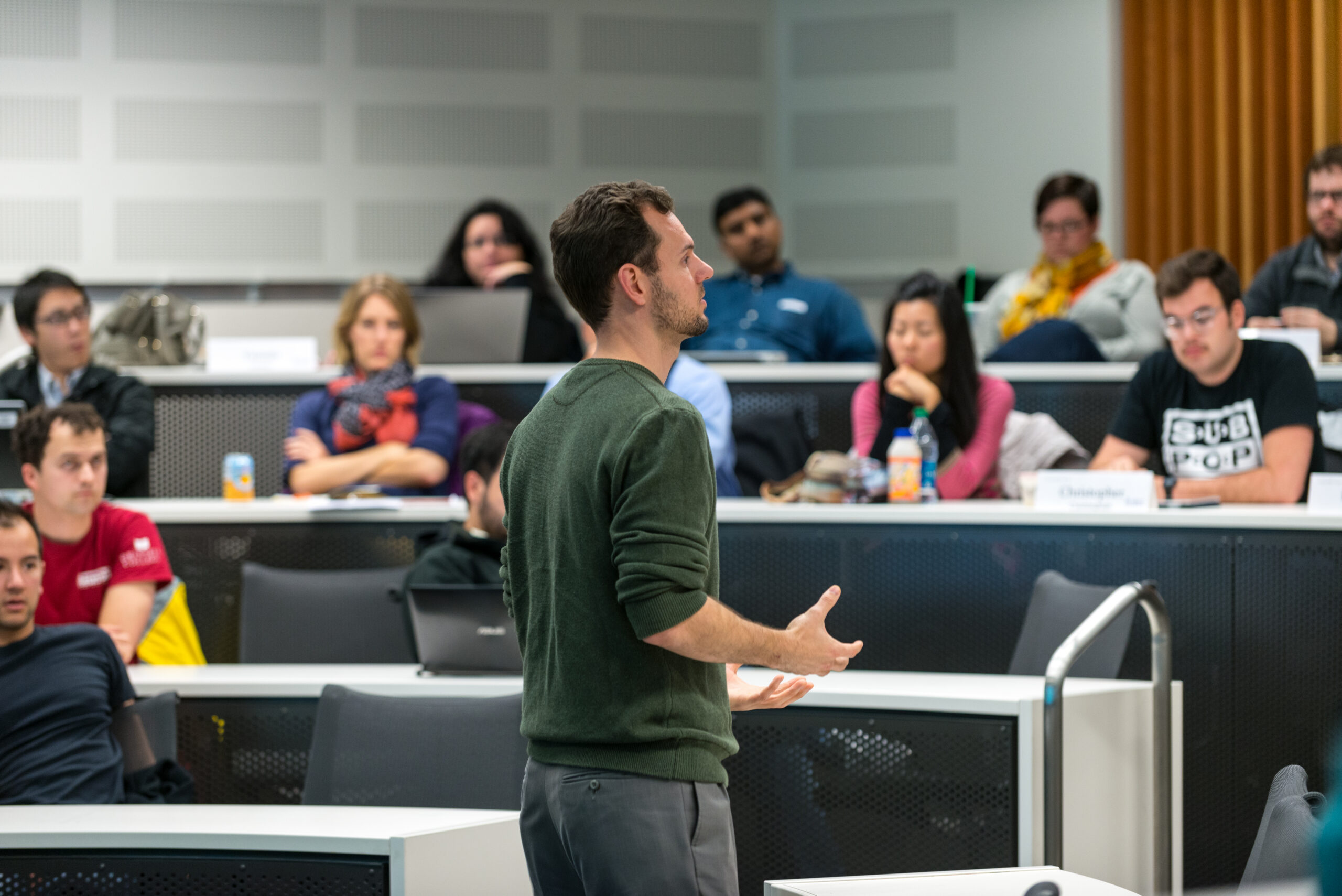
Christopher Barnes knows that a good night’s sleep can make all the difference in the classroom and the workplace.
Before you buy the glasses
Barnes’s first recommendation doesn’t require buying anything.
“The best thing you could do in the morning is get outside,” he says.
Even on cloudy days, sunlight delivers more blue light than the glasses, which in turn produce more than a smartphone screen. But if the weather or your schedule makes morning time outdoors difficult, the glasses could be a useful alternative.
Barnes also encourages people to do their research before buying any sleep devices.
“Where is the evidence behind their claim? Is there any independent evidence behind their claim?” he asks.
He also suggests considering whether a product’s claims are consistent with what scientists already know about sleep. A device doesn’t necessarily need its own clinical study to be effective, but there should be a sound scientific reason to believe it works.
Taking the long view
Of course, no device can make up for a work schedule that leaves too little time for sleep.
“You can always get your employees to work more hours,” he says. “But that runs up against the reality of human limitations.”
As sleep suffers, so can judgment, creativity, and teamwork. More hours may mean more mistakes and lower-quality work, a tradeoff Barnes thinks employers often overlook.
“In most cases, it’s better to work people less to get higher quality work out of them,” Barnes says.
He brings that perspective into the classroom through his new Foster MBA elective, Leading for Human Sustainability, which examines how organizations can help employees remain healthy and productive over time.
The course covers stress, emotional exhaustion, work-family conflict, sleep, and other issues that affect employees’ well-being. Barnes devotes an entire three-hour session to sleep deprivation, its effects on leadership and performance, and what organizations can do about it.
Sleep has been part of his leadership classes for years, and students were sometimes puzzled by his inclusion of the topic. But by the end, some were reconsidering their own habits, while others wanted to share what they’d learned.
“I want my boss to hear what you’re talking about,” is one response he hears.
But Barnes hopes his students take away something bigger than the importance of getting a good night’s sleep.
“I really want them to extend the time horizons for which they think about managing people,” he says.
Too often, managers focus on meeting the next deadline or hitting quarterly targets without considering the long-term costs to their employees. Pushing people too hard may help get a project finished, but it can also lead to burnout, illness, and turnover.
Thinking long term might mean negotiating timelines, requesting additional resources, or pushing back when expectations are unrealistic. Barnes encourages managers to “push back upward” rather than simply passing pressure down to their teams.
“I can do what you’re asking me to, but here’s the cost,” he suggests telling a boss. “Here’s the cost that you’re not seeing or not thinking about as far as our human capital. And what’s that going to do to us in the long run?”
Read the research: “Rise and Shine: Morning Blue Light Exposure, Sleep, and Work”, by Kathleen R. Keeler, Christopher M. Barnes, Yiming Huang, Brian C. Gunia, and Jason H. Moy, published online in the Journal of Applied Psychology (2026).
Christopher M. Barnes is the Michael G. Foster Endowed Professor and a professor of management at the University of Washington Foster School of Business.