

Phoebe Reid did not set out to get a Foster MBA.
For many professionals working in nonprofit and public sector roles, the idea of pursuing an MBA can feel misaligned. It may seem too corporate, too numbers-driven, or simply not relevant to the work they care about most. For Reid, business school was not the obvious choice, but it lingered in the back of her mind as a possibility.
With a background in sustainability and years spent teaching wilderness skills, Reid’s path was anything but linear. Her career unfolded across forests, fieldwork, and community-based education, guided by her commitment to mission-driven work and creating a positive impact.
Today, Reid works as a Program and Finance Manager for a nonprofit, leading initiatives that support economic development across Washington’s North Olympic Peninsula. It’s a role she once would not have seen as possible before enrolling in the Hybrid MBA at the University of Washington Foster School of Business.
Her path to a Foster MBA didn’t follow a clear trajectory. But that’s exactly the point.

“The Hybrid MBA makes it possible to keep working and still connect with my peers in person.” —Phoebe Reid
When IMPACT REQUIRES NEW SKILLS
A few years after graduating from the University of Washington with an undergraduate degree in environmental studies, she enrolled in a wilderness awareness school that focused on leadership through the lens of survival skills and a connection to nature.
She spent the following four years in a leadership role, teaching the survival skills that prove useful if you find yourself wandering the wilderness, intentionally or not.
It was meaningful, hands-on work. It was also where she began to discover a new area of interest.
“I was getting involved in budgeting and financial decisions,” Reid says. “I realized I really enjoyed that side of the work and that expanding my skill set could help me create even more impact.”
An MBA started to feel like the next step.
Reid knew how to connect with people and lead teams. What she lacked was the technical foundation to scale programs, manage finances, and make data-informed decisions.
RETHINKING THE ROI OF AN MBA for nonprofit leaders
“I knew I wanted to grow my career,” Reid says. “My dream was to buy a home and start a family one day, so I started looking at an MBA to gain the skills I needed to do bigger things.”
For professionals in the nonprofit or government sphere, the decision to pursue an MBA often requires a different lens. The ROI is less about salaries and job titles and more about expanding the scope of what is possible within the work they care about. For Reid, that meant building financial stability, opening more career opportunities, and moving between sectors if needed.
“I liked that the MBA gave me options,” she says. “I didn’t have to choose one specialty and could instead gain a broader perspective.”
Rather than specializing early, she wanted exposure to strategy, finance, operations, and leadership so she could apply those skills across industries.
That decision reflects a reality for professionals without a formal business background. The most valuable outcome is the ability to think differently, ask better questions, and approach problems with greater foundational knowledge.
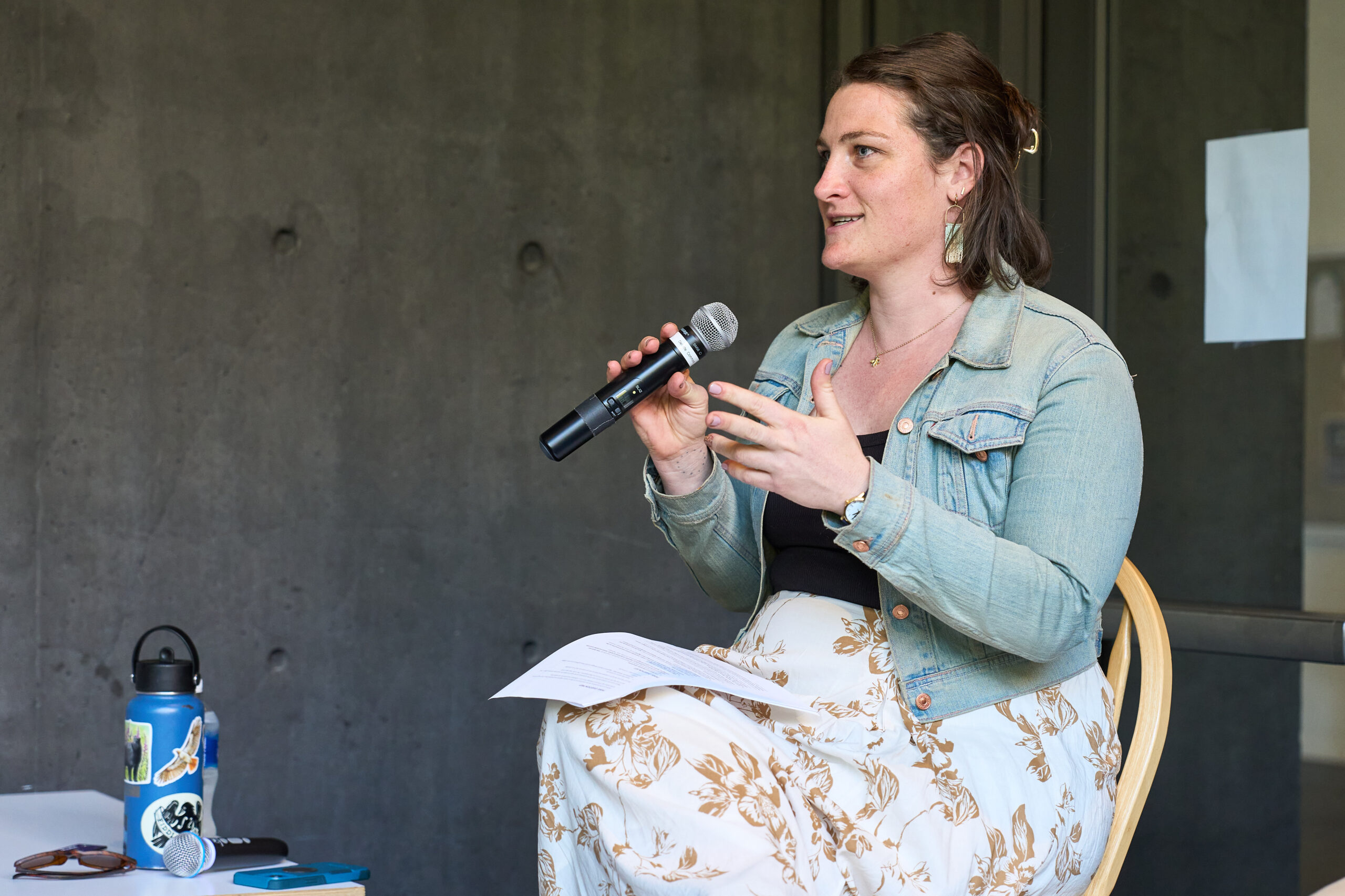
“I feel more equipped to support the kinds of impactful organizations I care about.”—Phoebe Reid
AN ONLINE MBA designed FOR FLEXIBILITY
Location and flexibility were critical factors in Reid’s MBA decision.
Based in Port Townsend, a picture-perfect seaport on the Puget Sound, she was too far from Seattle to commute. At the same time, stepping away from work for a full-time MBA was not financially realistic.
The Foster School of Business Hybrid MBA, which is mostly online, made both challenges manageable.
Designed for working professionals, the program combines online coursework with quarterly in-person immersions in Seattle, allowing students to continue working while building business fundamentals and leadership skills.
Enrolling in the Hybrid MBA also meant Reid could stay rooted in her community while advancing her education.
“I would not have been able to take time off from work to do a full-time program,” she says. “The Hybrid MBA makes it possible to keep working and still connect with my peers in person.”
For students like Reid, those in-person moments matter. Each quarter, Reid takes a scenic ferry ride to Seattle for immersion week, where she connects with her cohort on campus.
“We connect so much when we are together on campus,” she says. “It adds a layer to the experience that makes the Hybrid MBA program stand apart.”
Coming from a nontraditional background, Reid initially felt like an outsider. But over time, she found common ground with her peers, building meaningful relationships and a strong support system.
The flexibility also shows up in unexpected ways. During her first year, Reid found herself on a wilderness expedition with a looming finance assignment deadline. She ended up sitting under an oak tree, searching for a signal so she could hit submit. That is the kind of flexibility that makes Foster’s Hybrid MBA accessible.
BUILDING BUSINESS CONFIDENCE
Like many students with a non-business background, Reid entered the program with some hesitation around quantitative coursework.
“The intimidating part was doing math again,” she says. “It felt like I had to dust the cobwebs from a part of my brain I had not used in a while.”
The initial discomfort quickly turned into one of the most valuable parts of the experience. Through coursework in accounting and finance, Reid developed a new way of approaching problems. Instead of relying solely on intuition or experience, she began grounding decisions in data.
“Now, I find myself being the one who’s always asking, ‘Where is the data?’” she says.
The shift towards data-informed decision-making has already changed how she approaches her work and the way she measures success in her role.

“Becoming a finance manager is something I would have never had the confidence to step into before. The MBA gave me the skills to take that on.”—Phoebe Reid
Taking on what once felt out of reach
Since starting the MBA, Reid has made a significant career move. She transitioned into a Program and Finance Manager role, stepping into responsibilities that would have felt out of reach before starting her MBA.
“Becoming a finance manager is something I would have never had the confidence to step into before,” she says. “The MBA gave me the skills to take that on.”
In her current role, she manages a major federal grant and is focused on training business advisors who support small, local businesses in improving operations, marketing, and financial sustainability.
Reid has already begun applying what she is learning in real time. She has redesigned elements of the training program and collaborated with faculty to think through challenges.
“A huge benefit has been learning how to read data and quantitative information,” she said. “Now, I’m able to work backward to figure out how to achieve certain metrics and how to track those metrics over the next few years.”
Community impact with a business lens
Reid is applying business principles in a community-based and resource-constrained setting, a skill set that translates across sectors ranging from healthcare to education and the public sector.
Many of the small business owners she supports do not have formal business training. Reid sees her role as translating complex concepts into practical tools that can be used by business owners in real-world situations.
“How do I take what we are learning in class and make it accessible?” Reid asks herself. “That is what I think about in my work.”
The ability to interpret financial data and design sustainable programs has expanded her role, allowing her to contribute more strategically to the organizations and communities she supports.

From left, Phoebe Reid (Hybrid MBA student) with Foster alumni and Women in Leadership panelists Caroline Boren, Lucy Wang, Padmaja Vrudhula, and Anna Rainwater.
EXPANDING OPTIONS, MAINTAINING PURPOSE
As Reid reflects on her time at Foster, she believes that one of its biggest benefits is how the program elevates a student’s career both during and after the MBA. Her experience in the program reflects that momentum. Reid is a recipient of the Social Impact Scholarship and is currently on track to graduate with honors.
“I do not know exactly what my long-term path will look like,” she said. “But now I have the variety of skills that would apply to any industry, not just the public sector.”
Reid remains deeply committed to her community in Port Townsend and to bringing business thinking into spaces where it can drive meaningful change. She has already been approached about serving on boards for several organizations, opportunities she plans to consider after completing the program.
For now, she is holding off until she has more time. But it is easy to imagine a number of local organizations with her graduation date circled on their calendars, ready to reach out when she does.
“I feel more equipped to support the kinds of impactful organizations I care about,” she said.
For Reid, the value of the Hybrid MBA from the Foster School of Business is clear. It has expanded what she can do in her career and the impact she can have in her community.
An MBA does not require a business background. In many cases, those without one stand to gain the most.
And for Reid, that has made all the difference.
Learn more about the Hybrid MBA at the University of Washington Foster School of Business.