

“We are not in a doomsday scenario,” Manav Thiara (MBA ’12) told a room of Foster MBA students earlier this year. “We are in an acceleration scenario.”
He was speaking to students across the Executive MBA, Hybrid MBA, Global Executive MBA, and Technology Management MBA programs — not about hype, but about what artificial intelligence (AI) means for business leaders responsible for strategy, operations, and growth.
AI, he said, is advancing faster than any prior technology cycle.
“AI capability is improving faster than mobile. Faster than cloud. Faster than the internet. The scale of change on the technology front is unprecedented. Models will continue to evolve. Compute demand will continue to rise. Capabilities will compound.”
Thiara understands that acceleration from the inside.
As Senior Vice President and Technical Fellow at Sage, a global enterprise software company with more than 11,000 employees serving millions of businesses worldwide, he leads efforts to embed AI across enterprise platforms. His work spans data foundations, model orchestration, and what he describes as an emerging AI operating system governing scale, autonomy, and outcome-driven execution. Sage is leading the way as an AI-first company: architecting intelligence into every layer of its platforms while keeping customer trust, real-world outcomes and practical value at the heart of its innovation strategy.
Thiara emphasizes that acceleration does not mean instant adoption.
“Dispersion takes time. Institutions lag technology. Enterprises lag startups. That gap is the opportunity.”
His message to Foster MBA students was pragmatic: the gap between technological capability and institutional adoption is where leadership matters most.
For companies that truly understand their data (not just store it, but structure it, govern it, and activate it), this is a pivotal moment.
“Advantage will not come from access to a generic model. It will come from combining proprietary data, domain expertise, speed of execution, and workflow integration.”
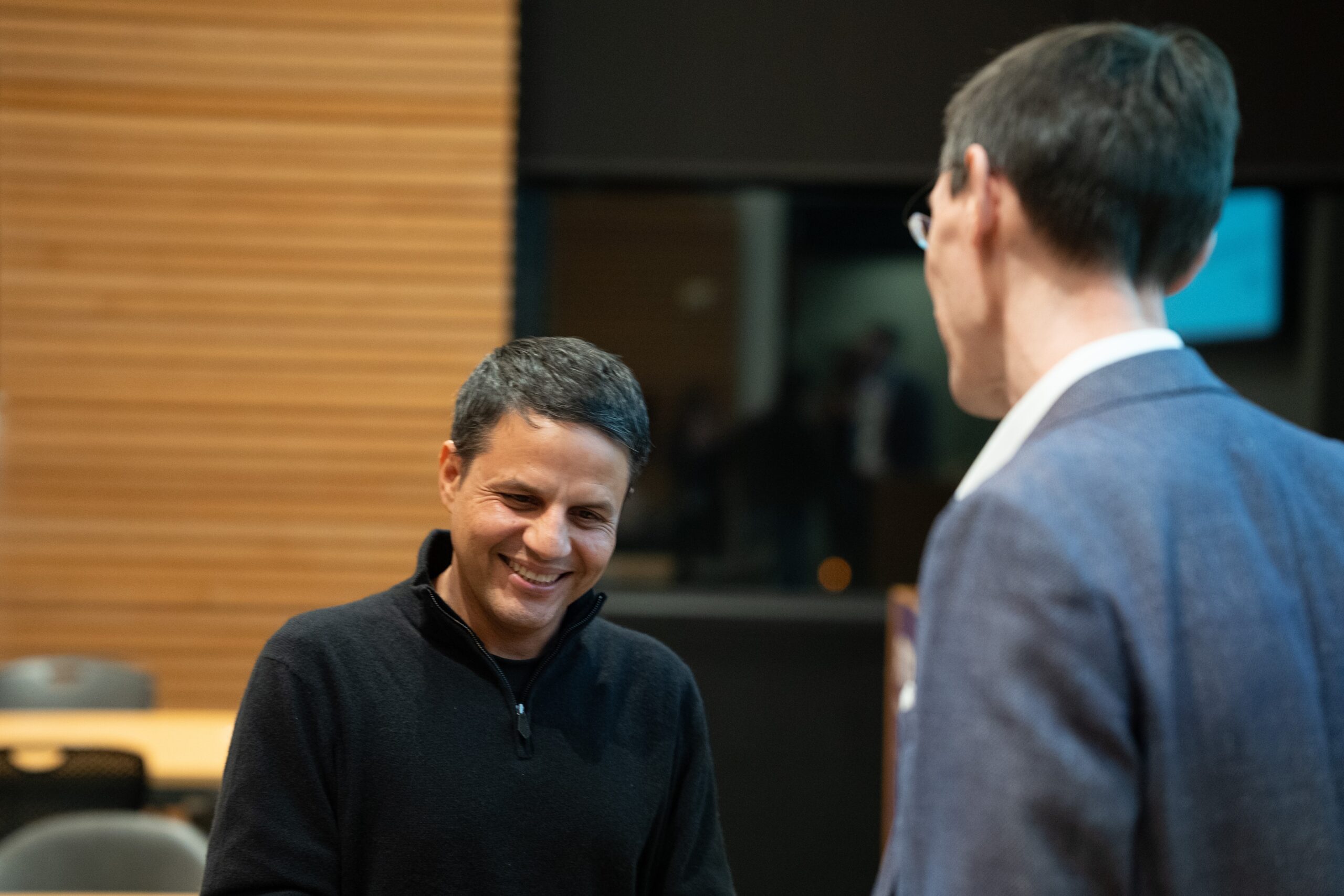
Ahead of his talk on AI and enterprise leadership, Manav Thiara catches up with Dean Frank Hodge
The Future Is Outcome-Based
What makes this shift different, Thiara explained, is not simply the speed of progress, but the structural change unfolding beneath it.
“AI will not simply enhance the application layer. It will reshape enterprise architecture itself.”
That transformation, he told the room, will alter how leaders interact with information and make decisions.
“The future is outcome-based. Customers will not care how the answer was generated. They will care that the problem was solved. The interface to information will change. Instead of navigating dashboards, you will state intent. Instead of querying data, you will specify outcomes.”
AI, he emphasized, is not a replacement mechanism.
“AI is not here to replace you. It is here to compress the time between intent and execution.”
That compression creates leverage, particularly for the kind of cross-functional leaders sitting in front of him.
“We now have leverage that previous generations of business leaders did not. You can build a market landscape analysis in hours instead of weeks. You can draft investor memos, board decks, and operating plans in a day. You can simulate business scenarios with AI-assisted modeling. You can generate customer personas from structured and unstructured data. You can prototype a product without writing a full engineering stack. You can analyze earnings transcripts across an industry in minutes. You can learn technical concepts like embeddings, APIs, or fine-tuning without a computer science degree.”
What concerns him more than fear about AI is disengagement.
“Logically, we know that a lot of what we hear about AI is hype; it’s marketing. Much of the technology is still in its early stages. It’s not good at everything, and maybe it never will be. But that also makes it the ideal time to learn and test new applications. These systems are still under development, and you can play an active role in how AI is integrated across your organization.”
For MBA students preparing to lead organizations, that engagement is critical.
In the past, meaningful influence over technology was primarily the domain of engineers. AI, he argued, is changing that dynamic.
“Previously, tech leadership was limited to engineers and computer science majors. Now, because of AI, there’s a leveling happening. You don’t need to be an engineer, but you do need to engage, learning the tools well enough to ask better questions and challenge assumptions.”
He believes most organizations already have more opportunities than they realize.
“Companies are sitting on data. The challenge isn’t access; it’s learning how to harvest it in ways that improve decisions and outcomes.”
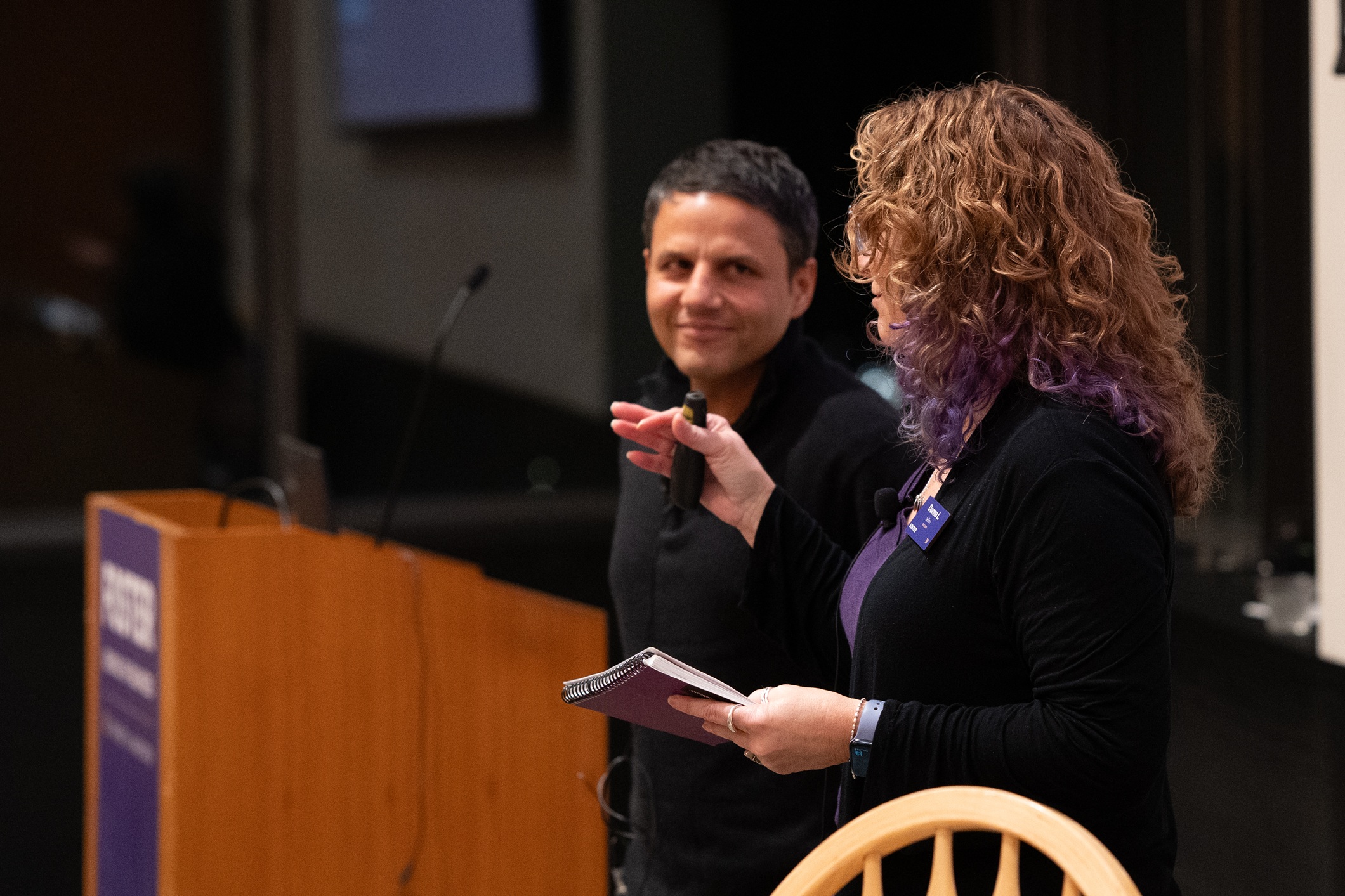
In conversation with Donna L. Sellers, Thiara addressed MBA students on the accelerating role of AI in enterprise strategy and leadership.
A Career at Inflection Points
The reason Thiara speaks about inflection points with such conviction is that he has built a career inside them.
Thiara studied computer science and engineering before moving to Seattle during the dot-com boom, drawn by the West Coast’s pace and possibilities. Early in his career, he learned to question default thinking: how companies build products and make decisions.
That instinct has followed him across leadership roles in diverse industries, from Microsoft to Premera Blue Cross and Blue Cross Blue Shield of Michigan, and from Fiserv to TD Bank and now Sage.
He pivoted from Microsoft into healthcare despite not being a healthcare expert, and sometimes the only non-healthcare person in the room. He took on leadership roles where the work was more than technical; it was about changing how teams collaborate and how organizations adapt.
Over time, a pattern emerged. No matter the sector, Thiara gravitated toward the same problems: how systems scale and how leaders can make better choices in a constantly changing environment. Eventually, he realized his passion wasn’t a specific industry. It was technology itself, and the responsibility that comes with shaping it.
The First Mile: The Foster Executive MBA Experience
Amid a demanding career, Thiara enrolled in the Foster Executive MBA program.
He was not looking to fill skills gaps. He was already advancing. What he wanted was expansion: an opportunity to think beyond technical execution and deepen his understanding of strategy, leadership, and risk.
“There is huge lasting value in your MBA,” Thiara says. “You come out a different person than when you started. You think differently. You’re mentally different.”
He acknowledges the measurable return: expanded opportunities, greater scope, career acceleration. But he is emphatic about something less visible.
“An MBA changes how you approach risk. It gives you confidence. It’s an investment in yourself. Never underestimate the qualitative return on investing in your personal development and education.”
That return compounds over time. The shift in perspective influences decisions years after graduation.
The MBA did more than expand his business toolkit. It reshaped how he understood leadership. Thiara continues to believe the classroom is one of the most powerful places to engage with change in real time because students hear directly from leaders building what comes next.
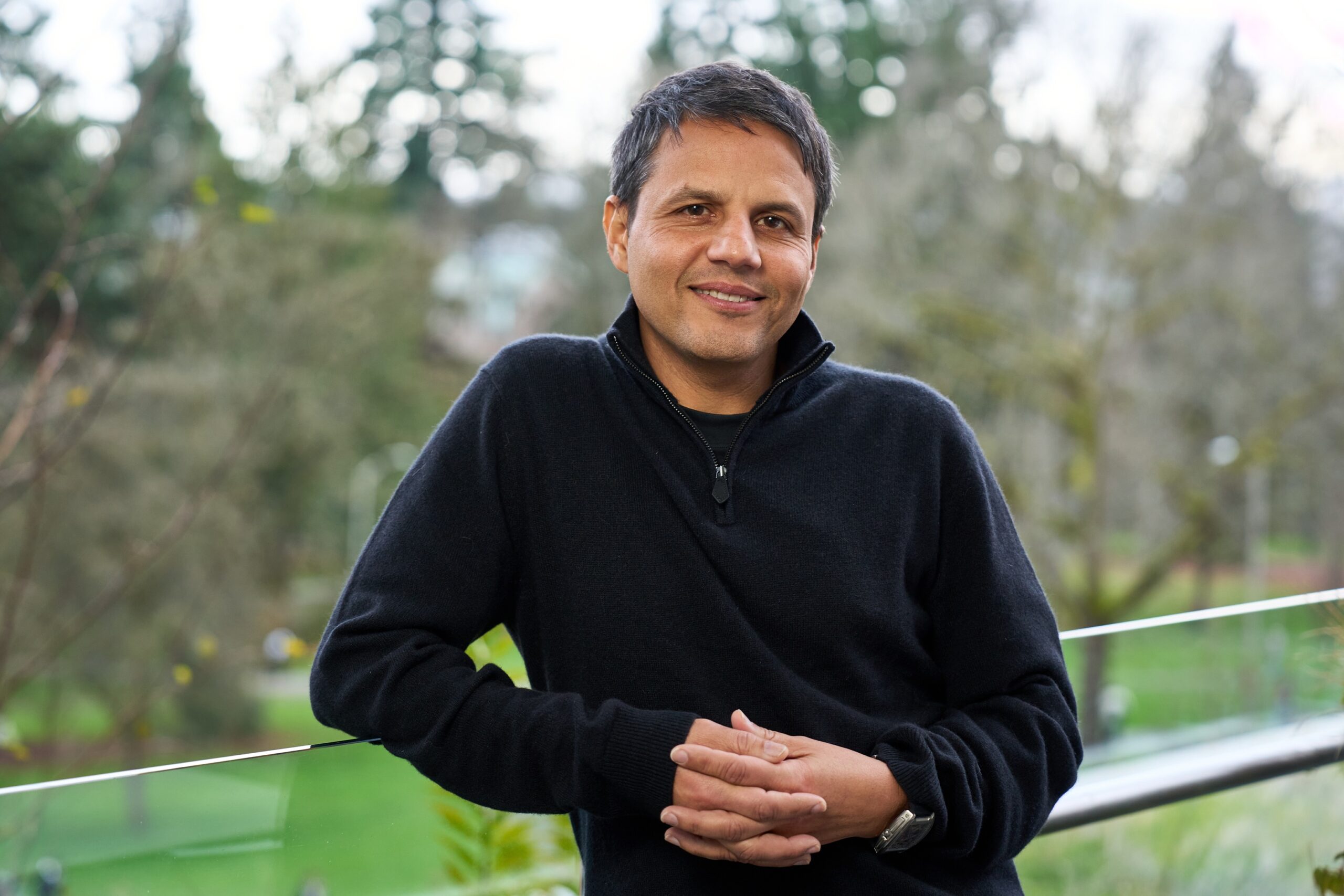
“We are not in a doomsday scenario. We are in an acceleration scenario.” During his Foster School visit, Manav Thiara reflected on the pace of AI and the responsibility business leaders have to engage with it.
Crossing the first finish line
Outside of work, Thiara is an ultramarathon runner, though he wasn’t always.
Ask him which race was the hardest, and he does not hesitate: the first one. He ran it in the Blue Ridge Mountains of Virginia and finished with seconds to spare.
“The first ultramarathon was the hardest because I didn’t yet know I could finish; I didn’t know I was capable of finishing,” he says. “You don’t know what you can accomplish until you do it. There is so much uncertainty. But once you know you can do something, your entire mental approach shifts.”
Taking the long view on AI
Thiara is also a lifelong learner—an avid reader who moves between biography, business, history, and physics. Recently, that has included Our Mathematical Universe by Max Tegmark, Shackleton by Ranulph Fiennes, The Wright Brothers by David McCullough, Abundance by Ezra Klein and Derek Thompson, Deep Work by Cal Newport, Humanly Possible by Sarah Bakewell, Battle of Ink and Ice by Darrell Hartman, and The Stalin Affair by Giles Milton.
He also listens to podcasts during long training runs, drawn to conversations about founders, infrastructure, and unconventional thinking: Acquired, Lenny’s Podcast, The Data Engineering Podcast, Dwarkesh Podcast, and Some Work, All Play, among them. The habit of learning across disciplines shapes how he thinks about AI.
For Thiara, perspective comes from many places: reading widely, testing himself physically, and staying in conversation with people who are navigating change in real time. The throughline is consistent. When he encounters something unfamiliar, he works to understand it.
Learn more about Foster MBA programs for working professionals here.