

University of Washington Foster School of Business professor Yong Tan has spent decades at the forefront of information systems research. With more than 100 published papers, over 30 doctoral students advised, and six Foster PhD Program Mentorship Awards, his accomplishments speak for themselves.
But Tan has also devoted extraordinary time and energy to developing the next generation of scholars, helping students pursue ambitious research, build successful academic careers, and find their own paths as independent researchers.
To better understand his impact, we caught up with nine former Foster PhD students who studied under Tan and have since secured academic appointments at universities across the United States and internationally. Their experiences reveal a mentor whose influence continues long after his students leave Foster.
Recognizing Potential Before Students See It Themselves
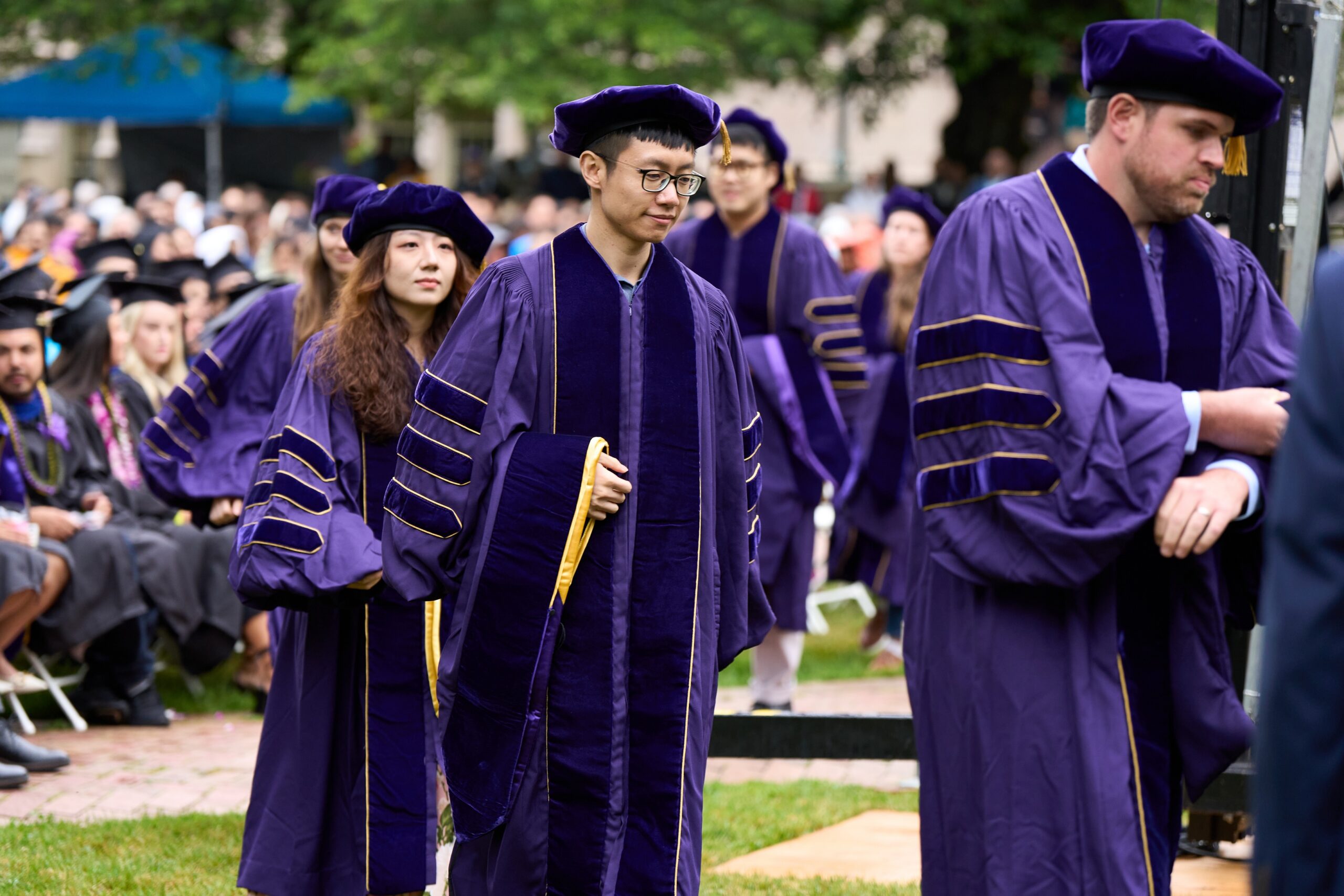
Yifan Yu (PhD ’23) at Foster commencement. With Yong Tan’s encouragement, he pursued an academic career he hadn’t initially envisioned.
For Yifan Yu (PhD ‘23), Tan’s mentorship changed more than his research interests. It changed the future he imagined for himself.
“When I first came to Foster, I had never seriously imagined that I would pursue an academic career,” said Yu, now an Associate Professor of Innovation and Information Management at HKU Business School, The University of Hong Kong. “Within only a few months, Yong saw academic potential in me that I had not seen in myself and fundamentally changed how I thought about my future. That decision ultimately changed the trajectory of my life.”
Yong Tan’s belief in his students was accompanied by a willingness to advocate for them, sometimes in ways they never knew about.
“When I was being recruited by UT Austin, one of my future colleagues later told me that Yong’s recommendation letter for me was one of the strongest recommendation letters he had ever seen,” Yu recalled. “I did not know this at the time, and that made the story even more meaningful to me. It captures something fundamental about Yong as a mentor: when he believes in a student, he supports that student wholeheartedly, often in ways the student may never even see.”
For Jane (Xue) Tan (PhD ‘17), Associate Professor in the Information Technology & Operations Management Department at the Cox School of Business, Southern Methodist University, the relationship between Tan and his doctoral students began with mutual respect.
“Yong is a top-ranked researcher, yet he is also incredibly down-to-earth and a friend who genuinely cares about his students’ professional development and happiness,” she said. “He calls each PhD student ‘prof,’ which I see as a sign of both his high expectations and his respect for us. Even while we are still professors in the making, he treats us as fellow scholars.”
That confidence in students extended to their choices about what to study.
“I chose to study social media fundraising, a topic at the intersection of social media and charitable giving,” she recalled. “This was not a popular topic, and his support for my efforts to explore this interdisciplinary area meant a great deal to me.”
For Jan Tan, the experience also shaped her understanding of what it takes to develop as a scholar.
“He encouraged us to learn ‘hard stuff,’ which has inspired me to embrace lifelong learning and explore new methodologies in my research. He is a scholar driven by curiosity, and I have learned to bring that same curiosity to my own work.”
High Expectations, Unwavering Support
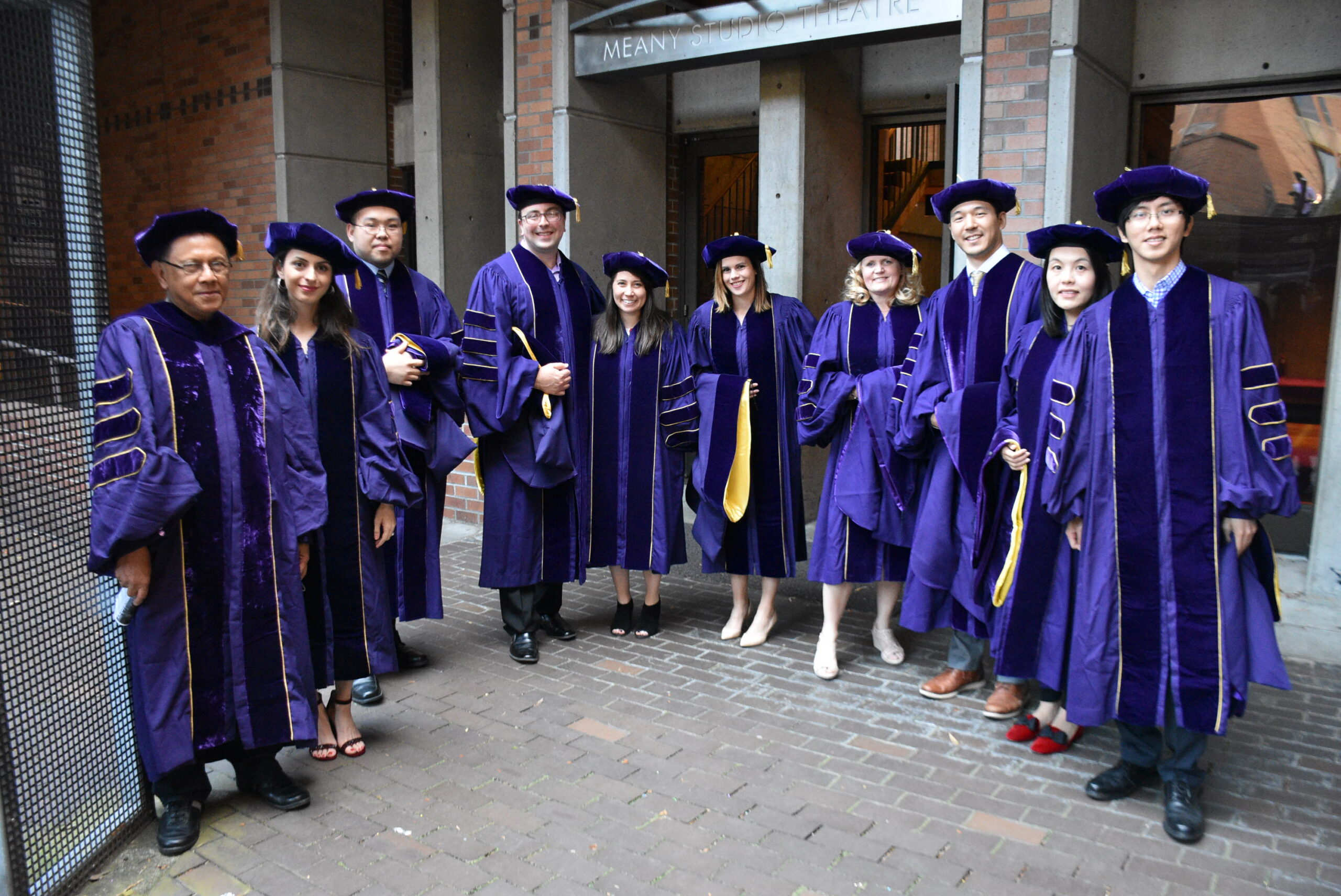
The Foster PhD Class of 2017 celebrates a milestone in the close-knit academic community shaped by Yong Tan’s mentorship.
For Jinyang Zheng (PhD ‘17), Assistant Professor of Information Systems at the Simon Business School, University of Rochester, some of the most important lessons of his doctoral education came outside the classroom.
“I remember spending many hours in his office discussing identification strategies and technical estimation problems until we found solutions,” Zheng said. “Jane (my academic sister) and I basically moved to his office in my year 4.”
One particularly demanding experience became a defining lesson in academic writing.
“I also vividly remember his edits to my first paper. He essentially rewrote it, but being able to follow every change taught me how to write a research paper. That editing process was perhaps the most effective learning-by-doing experience of my career.”
Zheng came to appreciate not only the expertise Yong Tan shared but also the time he made available despite a demanding schedule.
“Whenever you need Yong, he is there. We often spent his lunch breaks discussing research because that was one of the few times when he was not occupied with teaching or service.”
Years later, Zheng has a new perspective on just how much that commitment required.
“Now that I advise my own students, I realize how difficult that level of dedication is to sustain. I believe it comes from his genuine passion for discovery; he would rather sacrifice a lunch break than miss an opportunity to work through an interesting problem with a student.”
The Art of Mentorship
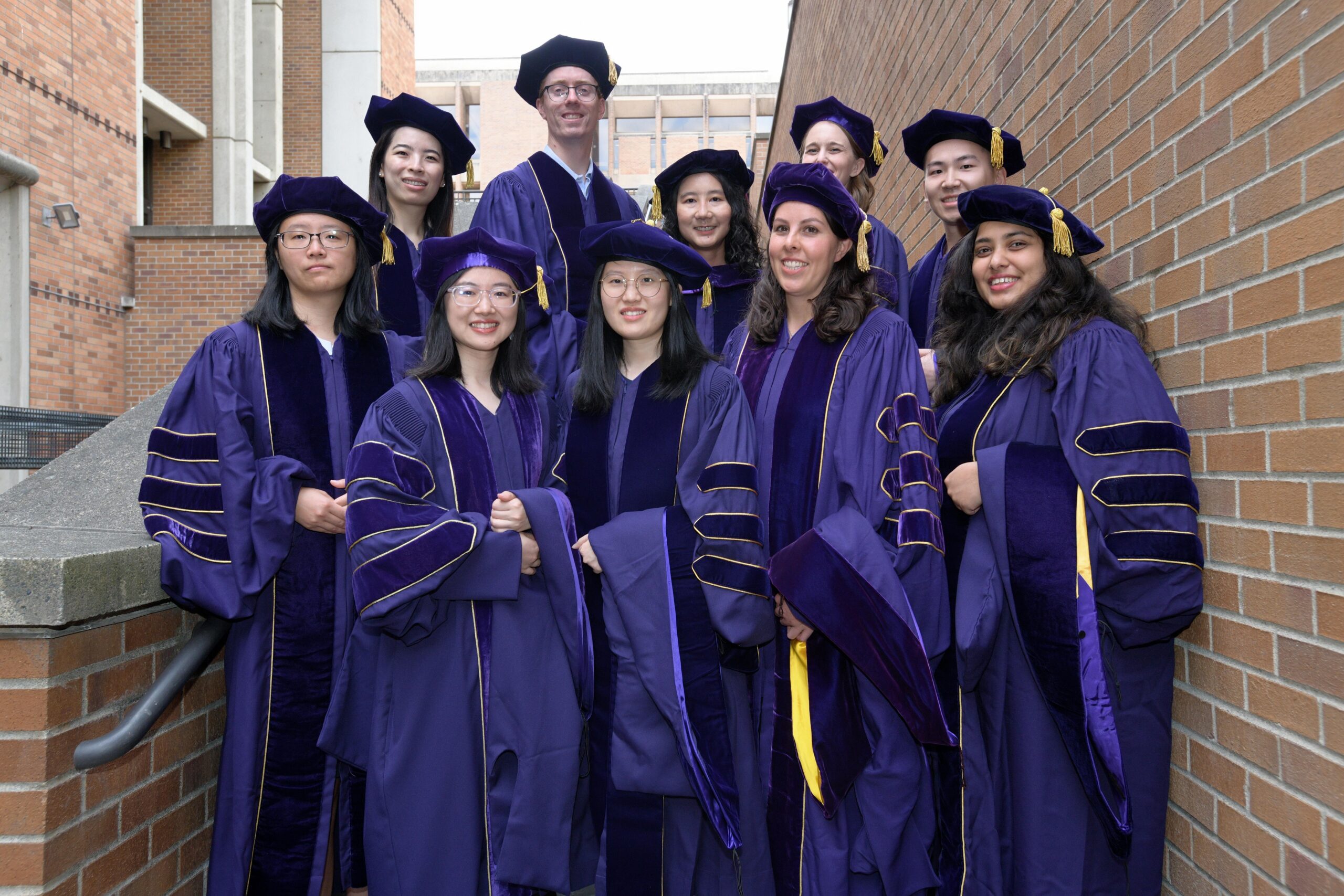
A little pre-commencement bustle as Ye Liu (PhD ’25), far left, and fellow Foster doctoral graduates get their academic regalia in order before the big moment.
Param Singh (PhD ‘08), Carnegie Bosch Professor of Business Technologies and Marketing and Associate Dean for Research at Carnegie Mellon University’s Tepper School of Business, found an unexpected way to describe Tan’s approach to developing independent thinkers.
“Yong always reminded me of Yoda, not in appearance or speech, but in the unnerving ability to make a student feel that the answer had been inside them all along,” Singh recalled.
For Singh, the comparison captures an approach to teaching that requires considerable patience.
“He rarely handed us answers; instead, he helped us see which assumptions were getting in our way. He taught by resisting the temptation to rescue us. His comments could be sparse, but they were precise. He had a gift for identifying the one assumption that was doing all the damage, and the patience to let us find our way back once he had pointed at it.”
That approach combined demanding standards with an openness to experimentation and discovery.
“Like Yoda, he cared less about impressive displays of intellectual force than about discipline: clarity before cleverness, evidence before confidence, and persistence before drama. He made scholarship feel demanding, yes, but also playful, a long conversation in which one was expected to bring one’s best ideas and be prepared to abandon them cheerfully.”
“Professor Tan’s mentorship felt personal because he invested in my growth beyond individual projects or papers,” Singh concluded. “He pushed me to aim high, while also making time to listen, talk through difficult moments, and help me navigate the uncertainty of finding my footing as a researcher. That combination of high expectations and genuine care had a lasting influence on my PhD journey.”
Giving Scholars the Freedom to Find Their Own Paths
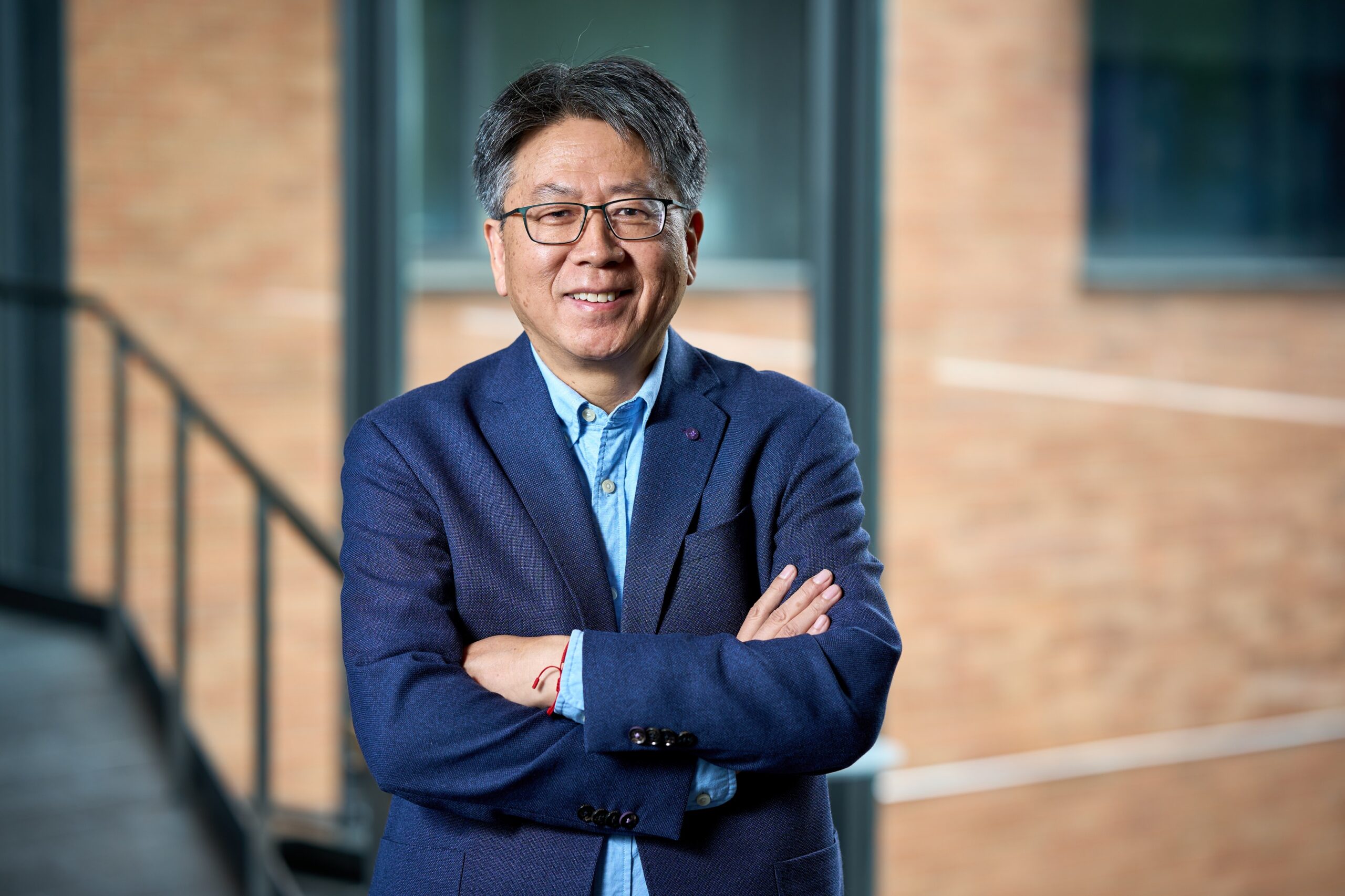
“What I appreciate most about Yong’s mentorship is that he never tried to turn his students into versions of himself.”—Lu (Lucy) Yan (PhD ’12)
Becoming an independent researcher requires more than mastering technical skills. It also means learning to identify meaningful questions and trust one’s own judgment.
Lu (Lucy) Yan (PhD ‘12), Professor of Information Systems and John & Esther Reese Professor at the Kelley School of Business, Indiana University, began working with Tan on research involving online healthcare communities, social networks, and social support. Those early projects helped establish the foundation for her subsequent scholarship.
“What I appreciate most about Yong’s mentorship is that he never tried to turn his students into versions of himself,” Yan said. “He pushed me to think deeply about why a question matters, to be rigorous and creative in how I answer it, and, at the same time, gave me the freedom and confidence to find my own intellectual path. That combination of high expectations and intellectual independence was incredibly important to me as a PhD student.”
For Ye Liu (PhD ‘25), Assistant Professor of Information Technology Management at the Scheller College of Business, Georgia Institute of Technology, the demands of doctoral research were inseparable from the personal encouragement that helped her navigate them.
“He did not tell me what to do. Instead, he gave me a tremendous amount of freedom and trust to explore my own ideas and develop my own judgment,” Liu said. “At the same time, he was always there when I needed him.”
“Whenever I have felt stuck, uncertain, or doubtful about a project, he has always given me very reassuring support,” Liu continued. “There were projects that, at different points, I was not even sure I was capable of completing, and his confidence in me helped me keep going.”
Those experiences also shaped Liu’s understanding of the relationship between a mentor and a student.
“He genuinely cares about his students as people. Sometimes that care shows up in very simple ways, such as having lunch together, checking in, or just making time to talk about life beyond research. Those interactions made the PhD experience feel much less transactional and reminded me that mentorship can be both intellectually demanding and deeply human.”
Encouraging Research Ahead of Its Time
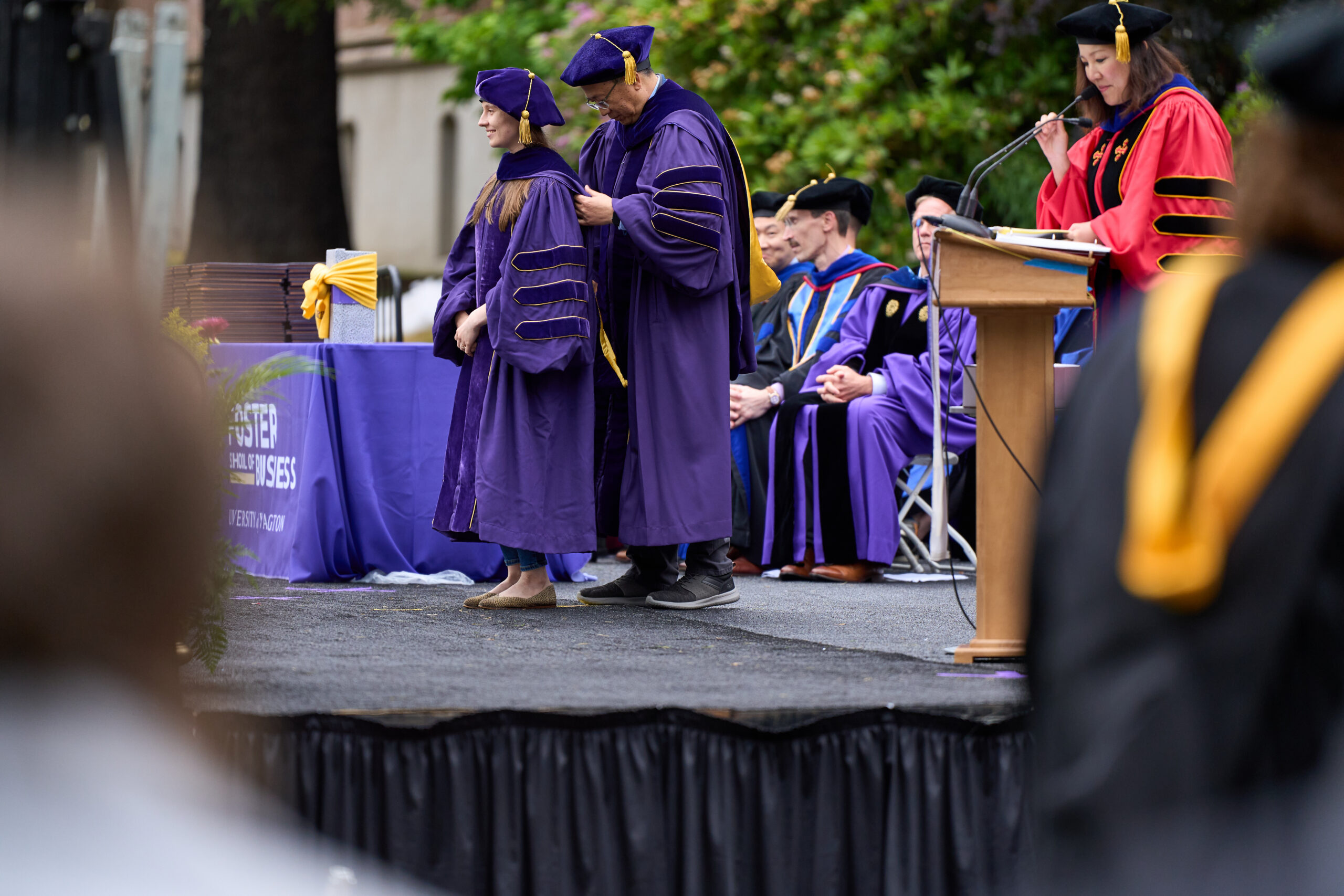
A defining moment in the doctoral experience: a new Foster PhD receives their academic hood, marking years of scholarship and perseverance.
Beyond teaching students how to conduct rigorous research, Tan encourages them to recognize important questions before they become established areas of academic inquiry. His ability to anticipate technological change gave emerging scholars the confidence to pursue ambitious, sometimes unconventional ideas.
“One of the qualities I admire most about him is his vision. He has always been extremely sensitive to important technological shifts and has encouraged his students to explore new areas early,” Yu said. “Long before AI became the central topic that it is today, he encouraged us to think seriously about AI-related research and gave us the freedom to pursue questions that were outside established research agendas.”
Yu also remembers a doctoral course that continued to evolve alongside the field.
“His PhD course, Empirical Methods in Management Research, had a particularly large influence on me,” Yu recalled. “Over the years, through the PhD program, summer schools, and other academic programs, I have probably sat through versions of that course seven or eight times. I continued to learn something new each time.”
“Part of the reason is the intellectual depth of the course, but another reason is that Yong continuously updates it,” Yu continued. “The course evolves with new methods, technologies, and research questions. That ability to combine enduring economic and managerial thinking with a very close understanding of the technological frontier has strongly influenced the way I approach my own research.”
Xingchen (Cedric) Xu (PhD ‘26), a Postdoctoral Research Fellow affiliated with the Center for Science of Science & Innovation at Northwestern University’s Kellogg School of Management, similarly credits Tan with encouraging research that pushes beyond established approaches, even when the path to publication is less predictable.
“A safer way to publish is to follow the existing paradigm on new questions, but we want to move to less-traveled roads to study questions that are new enough and require additional paradigm shifts on methods as well,” Xu said.
“These projects are risky but rewarding: although we usually need to conduct substantial revisions during the review process, these trainings are very valuable to push me to think more,” Xu continued.
He summarizes Tan’s approach in a single observation.
“Overall, Professor Tan always pushed us to think boldly and implement rigorously, so that we can become mature researchers.”
Building a Community of Scholars
Tan’s commitment to education extends beyond individual advising relationships. His former students also credit him with helping shape an intellectual environment in Foster’s Information Systems and Operations Management (ISOM) department where emerging researchers could learn from one another and from established scholars across disciplines.
Jane Tan recalls how the breadth of doctoral training helped prepare her for an academic career.
“Yong Tan’s and Ming Fan’s PhD seminars were invaluable in developing our theoretical and methodological foundations,” she said. “Yong also strongly encouraged us to take OM [operations management] courses, even as information systems students. Taking courses in inventory management, queueing theory, and mathematical programming was one of the best decisions I made.”
She credits his leadership in shaping the curriculum with giving students opportunities to develop expertise beyond their immediate research interests.
“These courses provided essential building blocks for my research, and this breadth of training would not have been possible without Yong’s vision and thoughtful planning as our PhD coordinator.”
Tan’s commitment to teaching also extends to Foster’s Master of Science in Information Systems (MSIS) program. For students in the one-year master’s degree, studying with one of the world’s leading information systems researchers offers an opportunity to learn directly from a scholar whose work has helped shape the field.
Opening Doors to Research Careers
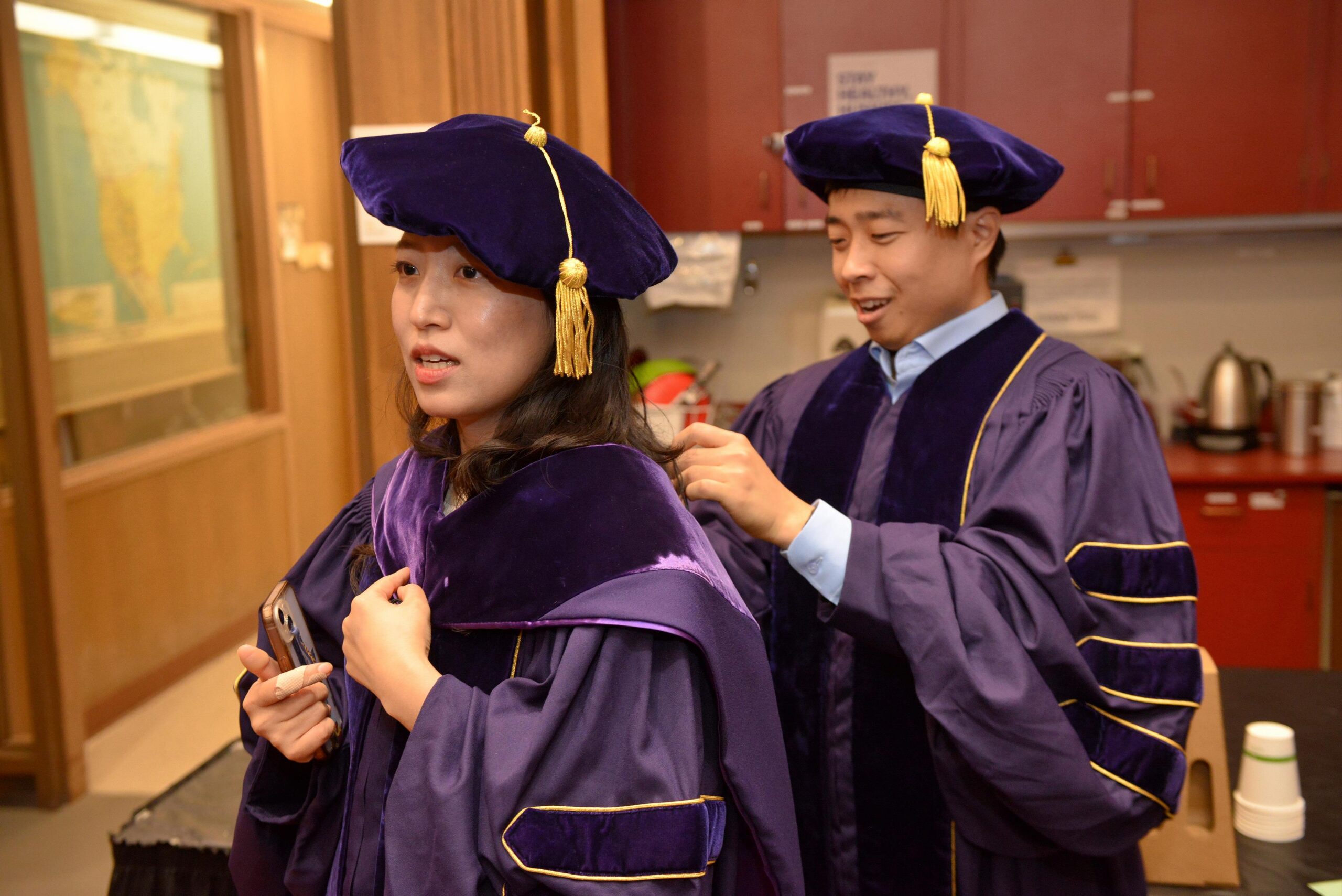
A little help before the big moment. A new Foster PhD gets a hand with her purple and gold academic regalia as she prepares for Foster commencement.
Tan also helps students develop relationships with researchers beyond Foster.
“Yong consistently encouraged us to ask questions during seminars and made every effort to connect students with visiting speakers, especially when their research interests aligned,” Jane Tan recalled.
For Tongxin Zhou (PhD ‘21), Assistant Professor of Information Systems at the W. P. Carey School of Business, Arizona State University, that independence was built on a relationship of trust.
“Professor Tan’s passion for research is infectious,” Zhou said. “One of my strongest memories from my PhD years is seeing students meeting with him back-to-back in his office whenever he was available. He genuinely enjoys discussing research and is always willing to spend time helping students develop their ideas. Despite being an extremely accomplished and intelligent scholar, he is also very humble and approachable.”
“His mentorship also went well beyond individual research projects. He frequently took students to lunch or dinner, where conversations could range from research to careers and life,” Zhou recalled.
For Yu (Rain) Kan (PhD ’24), Assistant Professor in the Department of Operations & Decision Technologies at the Kelley School of Business, Indiana University, Tan’s commitment to research was matched by his investment in the people around him.
“What has impressed me most is his dedication to research. He brings tremendous energy and intellectual curiosity to every project and is constantly thinking about how to identify important questions and make the research more rigorous and impactful,” Kan said.
“At the same time, what makes him an exceptional mentor is how much he cares about his students and colleagues. He is deeply invested not only in the success of a research project, but also in the long-term development of the people he works with.”
Xingchen (Cedric) Xu also credits the community in Foster’s Information Systems and Operations Management department with creating opportunities for collaboration and ongoing support.
“We have a very interdisciplinary department, full of faculty and PhD students with adjacent backgrounds in economics, computer science, and operations research,” Xu said. “We have a great atmosphere to learn from each other and collaborate closely to push the frontier. We also have a very close alumni network so that past graduates can support existing students in both research and general career path guidance.”
A Legacy That Continues Beyond Foster
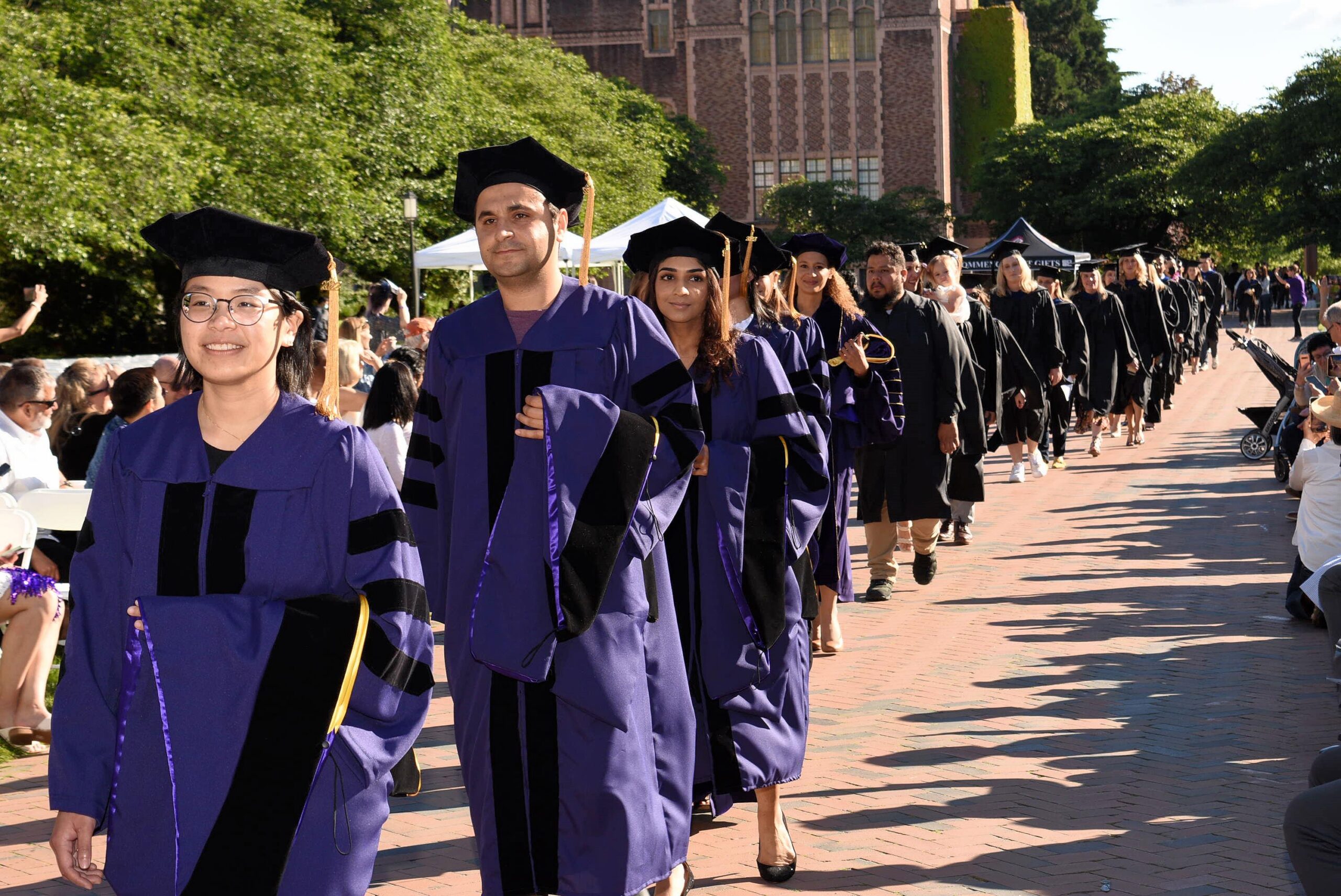
The Foster PhD Class of 2022 makes its entrance at commencement, joining generations of scholars who began their academic careers at Foster.
The influence of Tan’s mentorship does not end when his students graduate. Many are now mentoring doctoral students themselves, carrying forward the lessons they learned at Foster.
Zheng has gained a new appreciation for Tan’s approach through his own experience as a faculty mentor.
“What is truly remarkable about Yong is the way he balances unwavering support with the cultivation of intellectual independence,” Zheng said. “He is always ready to help and generously shares his high-level perspective on the frontiers of the field—insights that junior scholars are rarely able to develop on their own. At the same time, he does not intervene unnecessarily in the process of generating and developing ideas, which is at the heart of becoming an independent researcher.”
“Most profoundly, Yong taught me to aim high. His vision extends beyond information systems as a field and beyond publishing in IS journals,” Zheng concluded. “That ambition has become one of the guiding principles of my own career, and it is something I hope to pass on to my students.”
Yu (Rain) Kan sees a similar influence on the kind of scholar and colleague she hopes to be.
“He has shown me that academic excellence and genuine care for others are not separate qualities. His dedication to research, commitment to students, and generosity toward colleagues have provided an important role model for how I think about my own career.”
For Lu (Lucy) Yan, the influence remains visible even as her research has moved into new fields.
“My research has expanded from online healthcare communities into broader questions about social media, human-AI interactions, and data-driven decision-making, but the way I approach research still reflects many things I learned from Yong,” she said. “His mentorship has stayed with me well beyond my PhD, and I feel very fortunate that he has been such an important part of my journey as a researcher.”
“Looking back, Professor Tan has influenced not only how I conduct research, but also how I think about the kind of mentor and scholar I want to become,” Zhou said. “I hope I can give my own students the same combination of intellectual freedom, trust, reassurance, and genuine care that he has given me.”
Measuring Success Beyond Publications
Yong Tan’s contributions to information systems research are reflected in an extensive publication record and decades of scholarship. But another measure of his impact can be found in the academic careers of the students he has mentored.
Across universities and generations of researchers, his former students are advancing new ideas, contributing to their fields, and mentoring scholars of their own. Their accomplishments reflect not only the rigor of Foster’s doctoral training but also the personal investment that helped them become independent researchers.
Param Singh captures that legacy with a final reflection on the lessons he learned.
“Whatever success I have had since then rests in no small part on those lessons. The Force, as he might have put it, was learning to find my own way—both as a person and as a researcher.”