

At the first-ever AI Expo Day at the Foster School of Business, students in the Master of Science in Information Systems (MSIS) program stood beside their laptops, ready to deliver live demos of products they built from scratch.
One month ago, they were given a deceptively simple challenge: create anything you want using AI.
In practice, that meant building a fully functional AI-powered product — an app, an intelligent agent, an automated system — complete with a user interface and a polished experience that anyone could pick up and use.
The call to adventure came from Assistant Professor Léonard Boussioux, who asked students in his AI innovation class to identify a problem in their own lives and design a solution.
“I demonstrate a variety of tools in the classroom,” Boussioux explains. “The assignment was to engage students to solve a problem in their real lives and figure out how a workflow can solve that for them. They have to figure out the technology by themselves.”
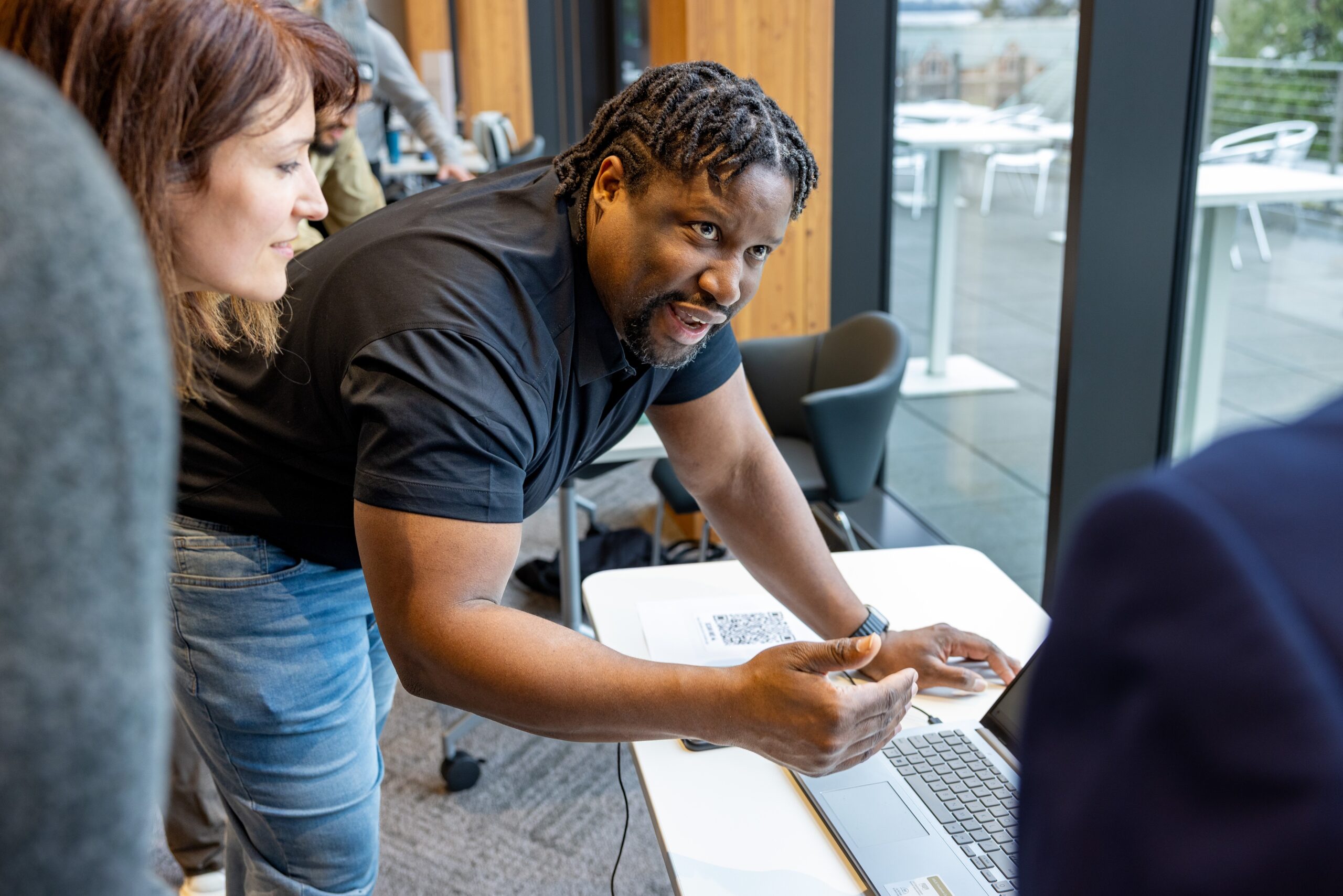
Each student built a fully functional AI-powered product and pitched it to a rotating group of judges during the event.
From classroom concept to live AI demo
Each student had an hour to demo their product and pitch to a rotating group of judges, explaining how their tool worked and why it mattered.
The format was intentionally conversational. Audience members drifted in and out mid-pitch, forcing students to adapt in real time, just like they would in a professional setting. Students had to engage, persuade, and clearly communicate the value of their ideas. This pressure was by design.
“This simulation of building an idea, launching it with AI, and pitching it is invaluable,” Boussioux says. “I’m very impressed with what the students have created.”
Adding to the excitement was a competitive twist: audience voting. True to form, Boussioux built a custom voting app specifically for the event, modeling the very creativity and resourcefulness he encourages in class. In every lecture, he builds niche applications to show students what’s possible with a little AI and a lot of imagination.
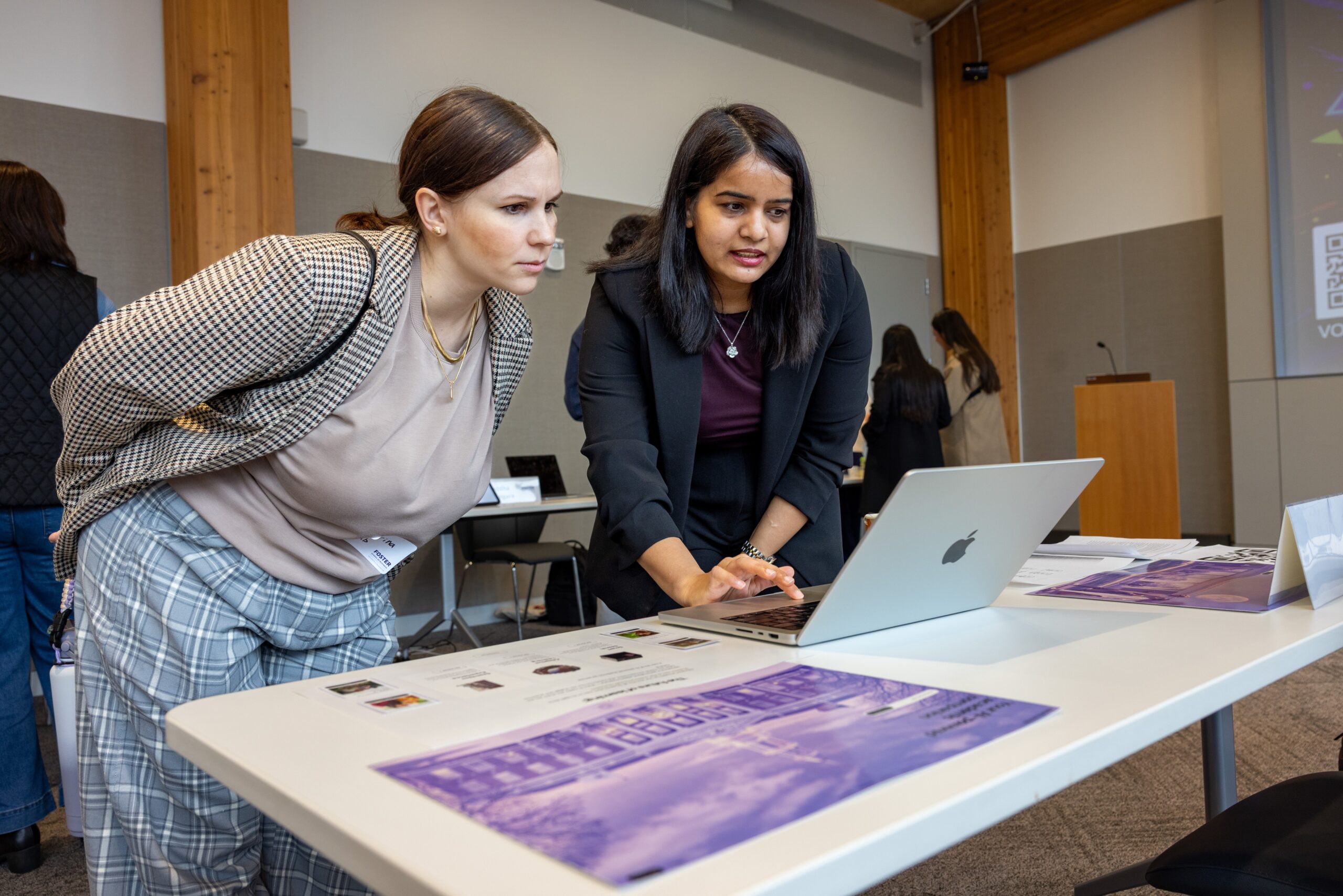
The event encouraged conversation, giving students the chance to demonstrate their work and gather feedback from alumni and industry professionals.
Passion projects powered by AI
The range of ideas on display reflected the cohort’s diversity and the assignment’s freedom.
- A voice-guided navigation app for visually impaired users and older adults that works indoors and outdoors from any smartphone browser.
- A lost-pet matching app that lets users upload a photo of a found or lost animal and surfaces the closest visual matches from real posts on an interactive map.
- A health app for people with histamine intolerance that tracks meals, models how histamine builds and clears over time, and predicts risk before the next meal.
- A civic engagement platform where an AI agent takes a user’s social issue and location, identifies their elected officials in real time, and drafts personalized constituent emails.
- A market intelligence system built for a real automotive supplier that reads industry reports, extracts key signals, and surfaces them in human-approved executive briefs.
- And dozens more, from a conversational plant-care assistant to a charity discovery platform, a museum visit planner, a personalized coffee app, a hiking trail recommender, a matcha sourcing guide, a smart travel planning agent, and a custom jewelry finder.
Students also created tutorials for their tools, ensuring their work is accessible to anyone beyond the classroom.
“All the skills we learned in the first few quarters have culminated in this moment,” one MSIS student shared. “It was challenging creatively, but I realized that my technical knowledge no longer limited me. If you have something you’re passionate about, anything is possible.”
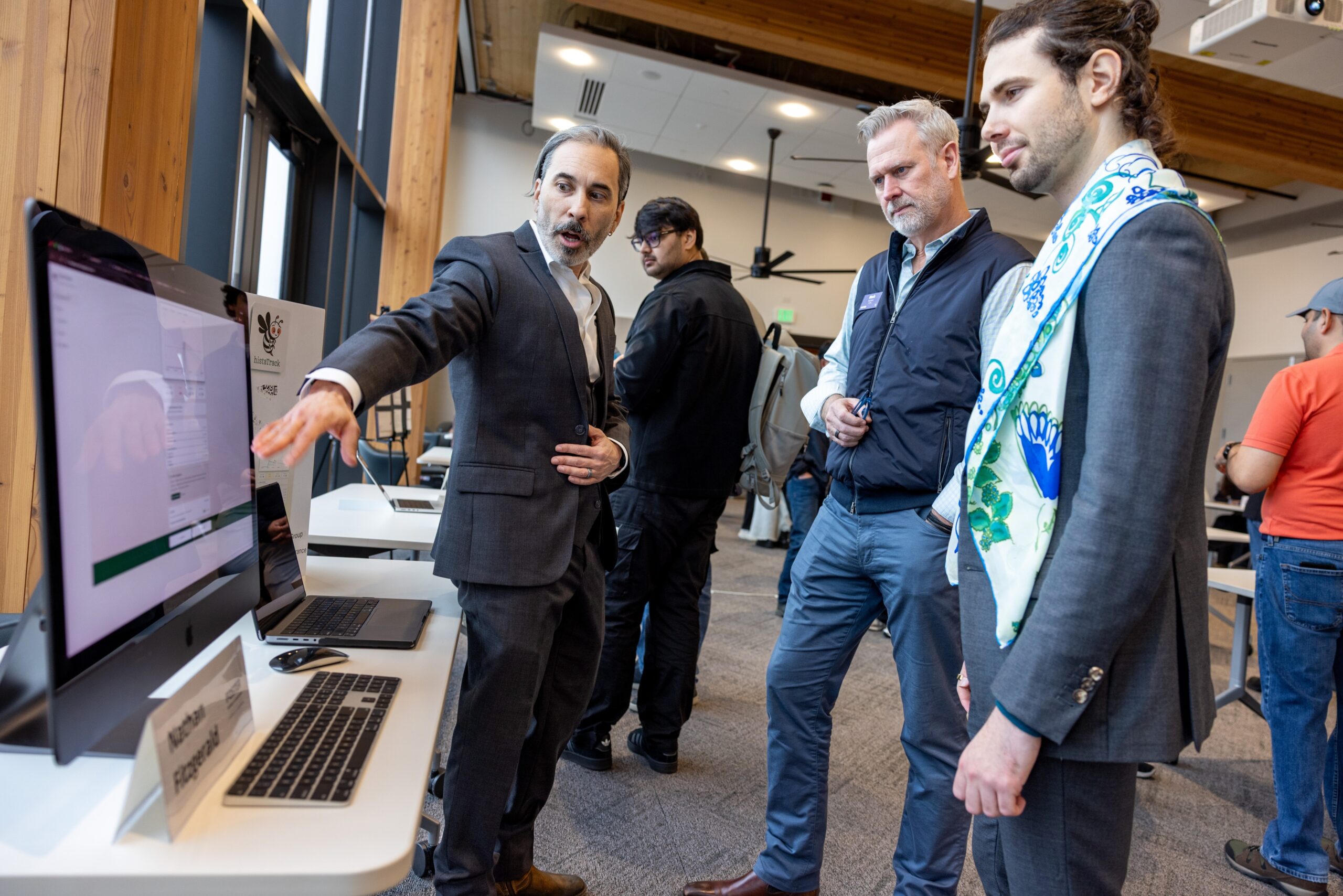
Léonard Boussioux (right) and Mark Forehand, Pigott Family Professor in Business Administration and and Associate Dean of the Master’s Programs (center), stop by a student demo to see one of the AI-powered apps built by the MSIS cohort.
The “Big Bang” teaching method
Boussioux describes his approach as a “creativity big bang teaching method.” Students engage with a wide range of tools, demos, and technologies in rapid succession. The next step is what Boussioux calls “the journey.” It’s a curated phase of exploration and discovery, where students experiment by combining tools, discovering new ones, and pushing beyond what’s shown in class.
Drawing inspiration from literature and theater, Boussioux structures his curriculum like an adventure story, complete with a setup, real stakes, and a finale. AI Expo Day serves as the transformation: the final challenge and ultimate resolution.
For one student, that dramatic arc became very real when their website crashed the morning of the event. Instead of panicking, they accepted the “major setback” portion of their adventure and troubleshooted the issue successfully using techniques they learned in class.
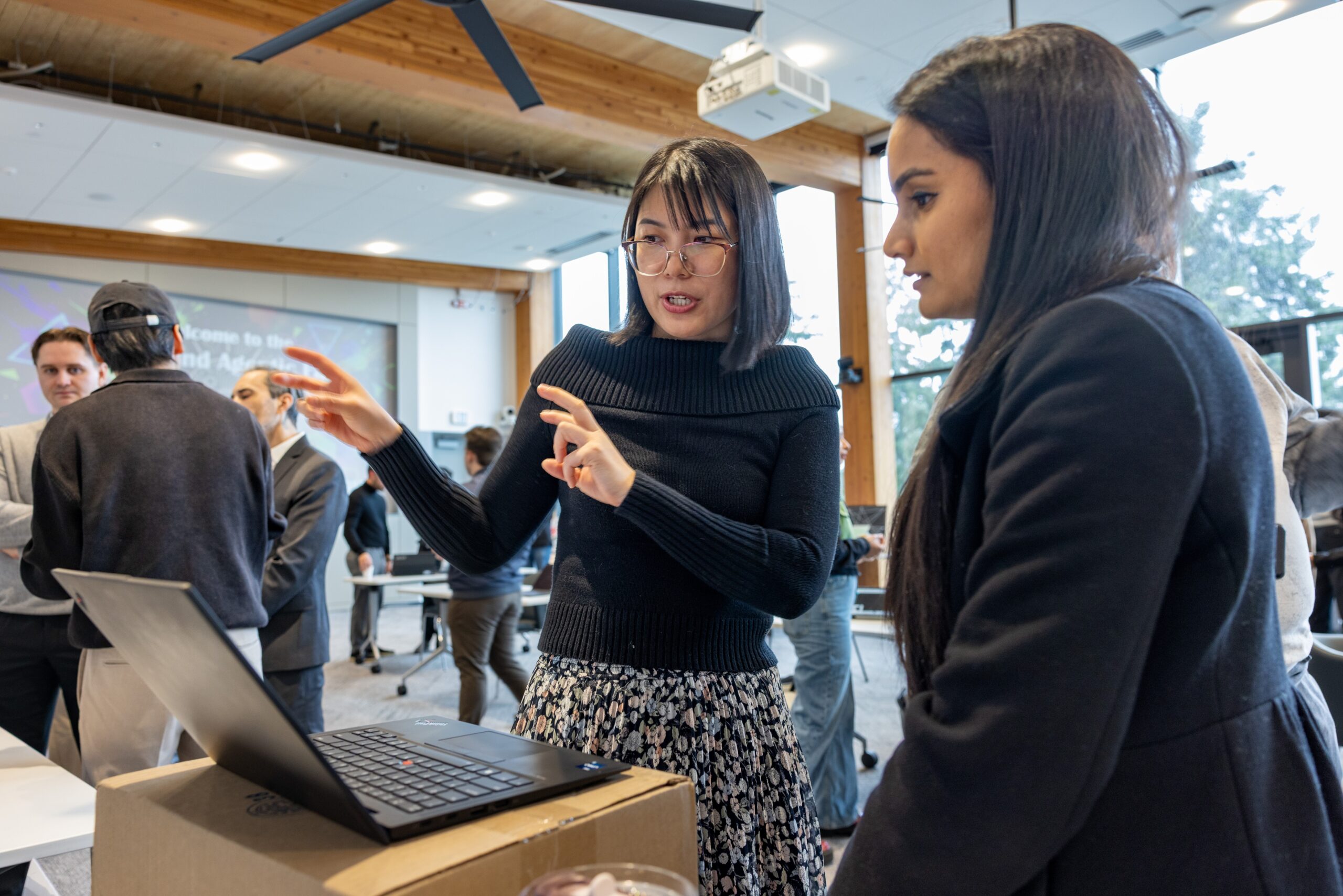
Foster alumni returned to campus to test student projects, ask questions, and vote for their favorite innovations.
Alumni return to see students solve problems in real-time
Beyond the student energy, AI Expo Day also felt like a reunion. Foster School alumni returned to campus in impressive numbers. Even though the promise of free coffee was tempting, they all confirmed their return to the University of Washington campus was motivated by a desire to reconnect and give back.
“When I was a Foster student, the alumni were always very involved and supported me so much, both personally and professionally,” one alum said. “I’m always trying to be involved, come back to Foster when I can, and give back in that same way.”
Some attendees were students – now alumni – from Boussioux’s first year of teaching at the University of Washington, who eagerly awaited their turn to reconnect with one of their favorite professors.
“Professor Boussioux is such a frontier man, so I was interested in seeing what he has his current students working on,” another alum shared. “I work with generative AI in my role, and I need to know what today’s students are thinking about. It’s a way to appreciate the innovation of the program, reconnect with fellow alumni, and bridge the gap between past and current cohorts.”
Alumni didn’t just come to observe. They served as judges, testing the tools, asking questions, and casting votes for their favorite projects. Throughout the morning, students and alumni networked and exchanged email addresses, reinforcing the program’s strong professional network.
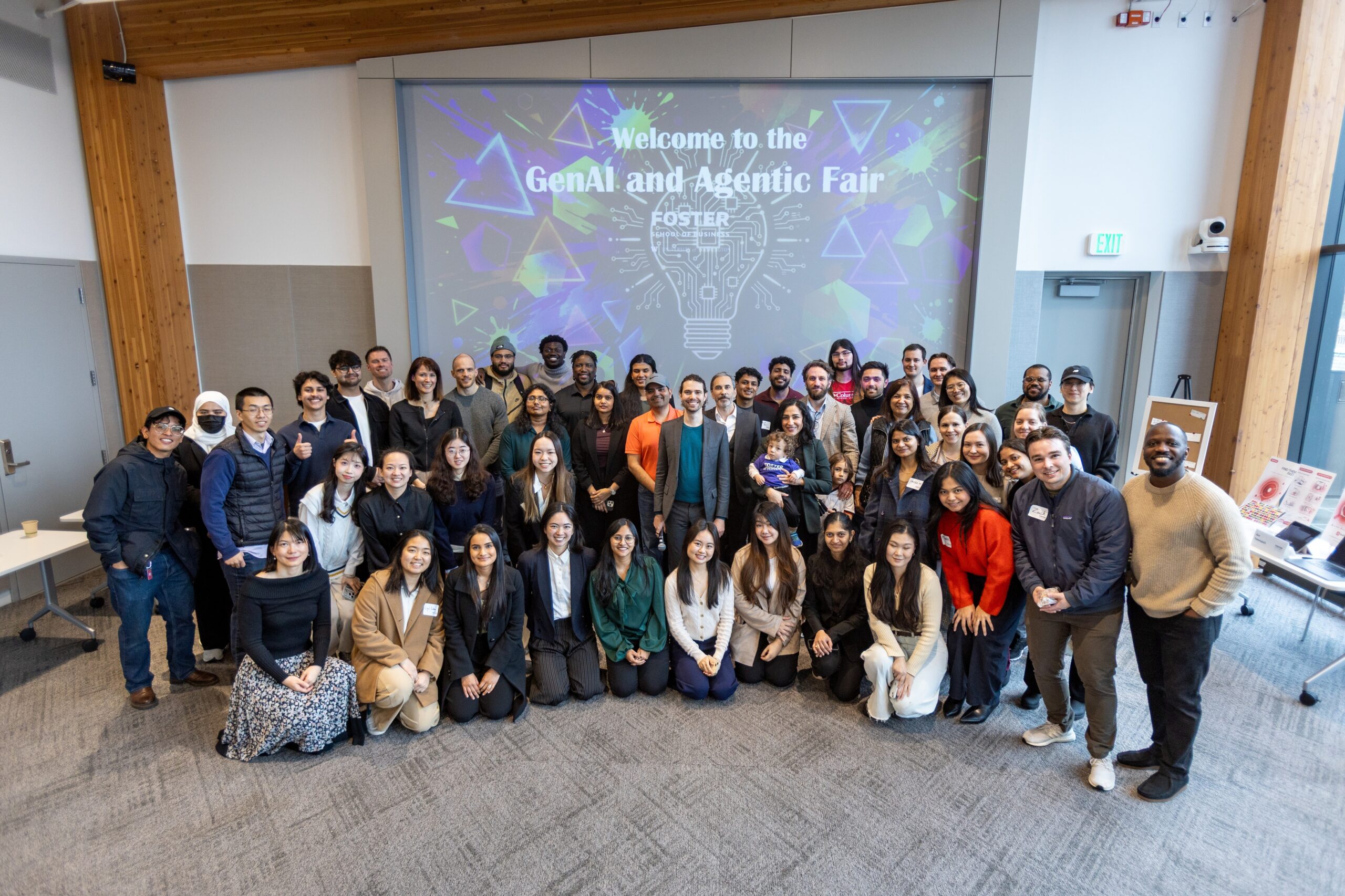
AI Expo Day brought together students, alumni, and faculty to celebrate the creativity and technical skills of the MSIS cohort.
A constantly evolving AI curriculum
According to Tal Lev, Assistant Dean of Specialty Master’s Programs, AI Expo Day was a first.
“Last year, the students were assigned group projects. This year, they wanted to do more individual work,” she said. “Professor Boussioux really listens to student feedback and adjusts this to be an individual project, allowing students to showcase what they’ve learned and really shine.”
Sydney Donaldson, Director of Student Affairs for Specialty Master’s Programs, echoed that sentiment, noting how Boussioux’s course continues to evolve alongside the technology itself.
“Even the alumni are praising how much this project has evolved,” she said. “Students can make more developed projects than they were able to make just a few years ago.”
Reframing the AI conversation about building something together
By the end of the event, the central question had shifted: not whether AI will transform the economy, but what role humans will play in directing it. Boussioux teaches his students to build, lead, and make decisions about AI, equipping them to shape how it is adopted, managed, and directed within real organizations.
The result is AI Expo Day, a networking hub and a launchpad for ideas rooted in personal passion.
A special thank you to the many alumni who returned to Foster to support and celebrate student innovations, and make the AI Expo Day a meaningful success.
Read more about the Master of Science in Information Systems program.